
On the surface, frontotemporal dementia (FTD) and amyotrophic lateral sclerosis (ALS) are very different neurodegenerative diseases. In FTD, people can experience drastic changes in personality and behavior as neurons in the brain regions that control decision-making and language die off. ALS, on the other hand, frequently begins with muscle weakness and difficulty with swallowing and speech as people lose nerve cells that allow the brain to control the body.
“They’re two very clinically disparate syndromes,” says neurogeneticist Bryan Traynor of the National Institutes of Health, who studies ALS. As a doctor, “you would not mistake them.”
And yet these two disorders may have the same underlying causes, as Traynor and Rosa Rademakers, a neurogeneticist who studies FTD, and their respective colleagues discovered independently in 2011. Though most cases of ALS are “sporadic,” or apparently occurring without a family history, 5 to 10 percent come from genetic causes that are passed down through families. After four years of scouring the genomes of affected families for a responsible gene, Traynor and Rademakers identified a mutation of a gene called C9ORF72 that many people with a family history of both diseases share.
On supporting science journalism
If you're enjoying this article, consider supporting our award-winning journalism by subscribing. By purchasing a subscription you are helping to ensure the future of impactful stories about the discoveries and ideas shaping our world today.
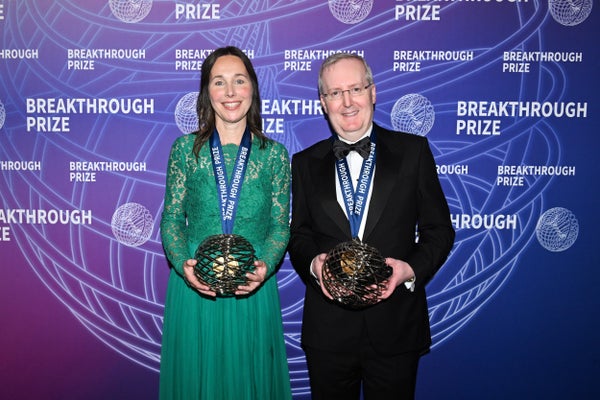
Their research revealed that these two very different disorders are part of the same spectrum of disease, leading doctors and researchers to rethink these conditions and potential treatments. Last weekend, at a star-studded ceremony in Los Angeles, Rademakers and Traynor were awarded a portion of the 2026 Breakthrough Prize in Life Sciences for this discovery.
Scientific American spoke with them ahead of the awards ceremony about what happened during the yearslong search for this genetic mutation and how it has changed our understanding of these devastating diseases.
[An edited transcript of the interview follows.]
Take me back to the late 2000s. Why did you think that frontotemporal dementia and ALS were related?
RADEMAKERS: I come from the frontotemporal dementia field, and Bryan [comes] from the ALS field. And my history was on genetics of FTD and families, where some individuals had FTD, some had ALS or some even had both. I think we made the assumption that it would be possible that maybe there was one gene mutation in those families that could potentially give rise to both diseases. But you still have to find the gene to actually prove it. But Bryan, you come from a different perspective.
TRAYNOR: We had discovered mutations in a [different] gene that was a known cause of frontotemporal dementia, and we had found that mutations in that same gene also caused ALS. And it kind of sparked that interest in [asking], “Well, are these two separate conditions? How do they fit together?”
RADEMAKERS: Also, in the brains of patients with all sorts of dementia, you usually have a protein that sits in the brain and causes the brain cells to die. This is [true] for Alzheimer’s disease, for FTD, for Parkinson’s disease—but they’re different proteins. But a few years before our discovery, researchers found that the same protein [called TDP-43] is found in the spinal cords of patients with ALS and in the brains of patients with FTD. Maybe the same process could be underlying it, just [with] different areas of the body [being] affected.
How did you start looking for the responsible gene?
RADEMAKERS: We had already narrowed it down to chromosome 9—[many families with ALS or FTD] shared a piece of DNA on that chromosome that healthy individuals did not have. Bryan was at the NIH, and they had access to technologies that we didn’t. He reached out to me to say, “Hey, can we potentially also study the families that you've been working on?” Then we really worked together closely and tried this new method—which initially led to nothing.
In the initial pass of that data, we still didn't see [the mutation]. Usually, there’s one letter of the [genetic] code that's different, but that was not the case. Eventually, in our lab, we started focusing on the idea that it could be a special type of mutation called a repeat expansion, [where a snippet of the genetic code is repeated over and over again]. Repeat expansions have been shown in lots of neurological diseases. There was a part in the genome [in the gene C9ORF72] that was six letters, GGGGCC, repeated three times. We had to develop a new method to actually look at these repeat expansions. After that, we were able to see that all the patients had hundreds, even thousands, of copies of this repeat.
We both stumbled upon the repeat independently, and then, because we had been working together, I called Bryan to say, “Hey, I think, you know, we found it.” And then he’s like, “Yeah, I think we found it as well!” So we published it together.
Is it unusual for a genetic mutation to have so many repeats?
TRAYNOR: We all have areas in our genome that are repetitive, but they’re constrained to a certain size. But then to have [this mutation] be so massive and so many repeats stuck in there, that is unusual. It certainly was the reason why it took so long to find it. I mean, it took us four years!
How do you think that this genetic mutation leads to both ALS and FTD?
RADEMAKERS: It’s a complex mutation that, broadly speaking, does two things. [First], it creates bad “extra things.” Even though the repeat is in a noncoding region of the gene [one that doesn’t contain instructions to build specific proteins], it has been shown to actually make toxic RNA and very small, toxic proteins. Bad things are being made from the repeated sequence, that’s the bottom line.
[Second], the position of the mutation is right in front of this C9ORF72 gene, and because of that, something like 50 percent of the normal production of the protein created as a result of that gene is lost. For a long time, people thought that this probably didn’t contribute to the disease. But that’s not true. We know [the C9ORF72 protein] works in clearance of debris in cells. It’s also involved with the immune system of the brain, so it has really important functions. And I think, nowadays, people agree that there’s both the creation of the toxic peptides or RNA, as well as the loss of the normal function that jointly leads to disease.
But we do not know the whole story yet. Somehow these things are driving this TDP-43, which is actually the protein that is found in the spinal cord and the brain [in ALS and FTD]. And it’s ultimately, I think, the TDP-43 protein that kills the brain cells. But the exact connections between all those things is still, even 15 years later, not fully known.
TRAYNOR: One of the ways I like to sort of say this is that you’ve got an incredibly complex disease in the most complex organ in the most complex species, humans. In general, perhaps we shouldn’t be surprised that the actual mutation is incredibly complex.
How does learning that these two diseases are connected help you understand and treat them?
TRAYNOR: It has led to a bit of a change in the field, whereby ALS patients have been examined much, much more carefully than ever before to look for those cognitive and behavioral changes [that are signs of FTD]. And when you do that, you do find changes. Before, it may have been that the actual symptoms of ALS were masking those changes [in speech and behavior] used to diagnose FTD.
RADEMAKERS: Still today, though, ALS and FTD patients are usually also seen at different clinics. In a dementia clinic, they don’t notice the small changes that are typical of ALS that Bryan would immediately see. But they clearly are related.
TRAYNOR: If you look hard enough, you’ll see it.
What does knowing the specific genes involved allow scientists to do that they couldn’t do before?
RADEMAKERS: Now genetic testing is possible for the next generation—because if you have a genetic mutation, your children can be tested, if they're willing to be. This gives us an opportunity to look at the earliest stages of the disease [in people who don’t have symptoms yet]. This allows us to study them and identify the subtle early changes to then recognize other people that are maybe on the way to developing disease—and hopefully intervene early.
Obviously, the ultimate goal is [to develop a treatment]. Based on what we already know, companies [went] ahead and started with clinical trials [of a technique] to actually try to eliminate the toxic proteins. It’s called antisense oligonucleotide therapy, or ASO [therapy]. Unfortunately, it was not successful [in trials that have been completed so far], maybe because they didn’t provide back the protein [made by the gene C9ORF72], which was the other part of the problem. There’s lots of research still ongoing, and the clinical trials will likely soon start again with slightly different approaches. And I do really think that there will be a therapy for these patients in the foreseeable future.
What are the big questions you’re trying to tackle now?
TRAYNOR: One burning question is: Why, in the same family, do some patients get ALS and others get FTD?
RADEMAKERS: That’s what I was going to say, too. After 15 years, we don’t understand why. We believe that there potentially are other genetic factors that can act upon the mutation, and maybe that pushes you more toward ALS or FTD. Or [there could be] lifestyle factors, potentially, although there is no specific evidence [for what factors those could be]. The other thing is: there are some individuals who have lived until they’re 80 years old with a [C9ORF72] repeat expansion, who remain healthy. And I think there’s a huge opportunity there. If we can understand why they don’t get disease, this is something we could potentially mimic for treatments.
I work in the FTD genetics field, and it is still quite distinct from the ALS genetics field, even though we know the diseases are related. These patients are seen in different clinics. There are different research groups that lead the fields. We really have to come together. [We could] compare the DNA from the patients who have FTD to the DNA from the patients that have ALS, both having the [C9ORF72] mutation, and see what else they have and how they differ. I think that would be very enlightening.
TRAYNOR: Rosa, do you want to do it? I’ve got all the ALS cases, and you’ve got all the FTD cases.
RADEMAKERS: Yeah, I think, definitely, this should be done.
TRAYNOR: Let’s talk about it in L.A.!