
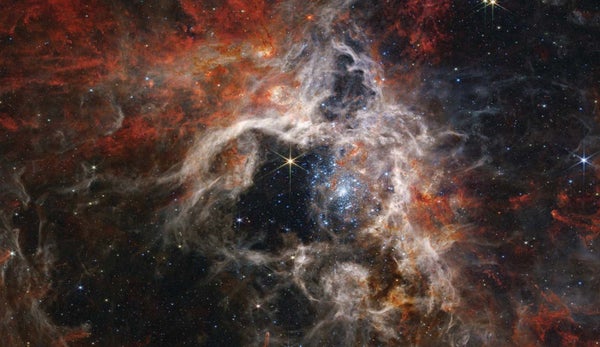
Close your eyes and imagine “space,” and there’s a good chance your mind will pull up a picture taken by Hubble. The space telescope became a household name in the 1990s as the images it captured appeared on TV and in magazines, newspapers and movies. Over the decades it created a shared visual lexicon of outer space and seeded multiple generations’ imaginations with visions of glowing nebulae, haunting planets and faraway galaxies. More than 30 years after launch, Hubble is still going strong. But now its successor promises to outdo it.
The first photos from the James Webb Space Telescope (JWST) went out to the world on July 12, 2022, and they are stunners. The clarity and level of detail are unprecedented. Seeing the telescope’s new views of some familiar objects—from the oft-photographed Carina Nebula to the planet Neptune—feels like putting on new glasses with a stronger prescription. Only the first batches of JWST photos have been released so far, but each image has created a stir, suggesting that in the coming years the telescope’s pictures will infiltrate the public subconscious just as thoroughly as Hubble’s.
The triumph is especially sweet given what it took for JWST to get here. Scientists started planning it more than three decades ago, and the effort to build the observatory fell so far behind schedule and so far over budget that many feared it would never be launched at all. When the telescope finally lifted off on December 25, 2021, with an ultimate price tag of nearly $10 billion, astronomers felt a rush of relief. In the subsequent six months JWST proved to be working even better than planned, and astronomers really began to enjoy themselves.
On supporting science journalism
If you're enjoying this article, consider supporting our award-winning journalism by subscribing. By purchasing a subscription you are helping to ensure the future of impactful stories about the discoveries and ideas shaping our world today.
Now scientists are ecstatic. In the three months after the initial results from the telescope were released, scientists submitted some 200 papers interpreting them to the preprint server arXiv. A deluge is sure to follow—the telescope’s initial observing time is already spoken for by the lucky researchers whose proposals won out in a highly competitive peer-reviewed selection process.
In the following pages, we’ve collected some of the cosmic portraits JWST has given us so far. We show how scientists create finished images from the telescope’s raw data. Journalist Jonathan O’Callaghan explains how some of those photos have already thrown the field of cosmology into crisis. Astrophysicist Fabio Pacucci describes how Hubble and JWST have changed science by taking pictures of “empty” space.
Soon the first image we call to mind when we think about space may well be one of JWST’s. How long it will run and what its ultimate legacy will be are still open questions. But it’s certainly off to a shining start.