How Mistakes Help Science [Video]

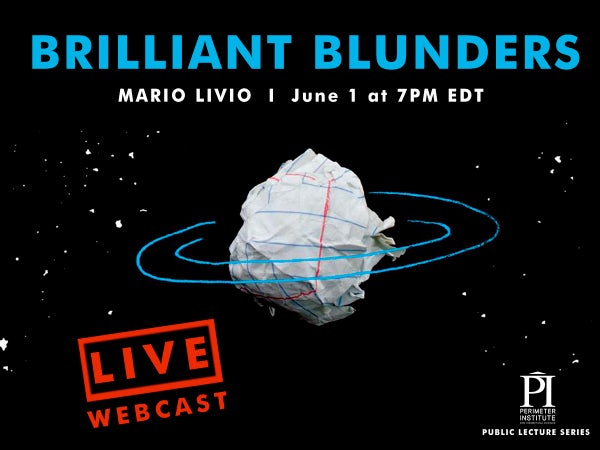
Astrophysicist Mario Livio will discuss how famous thinkers’ blunders have played a vital role in research during a live Webcast tonight at 7 P.M.

Perimeter Institute

Join Our Community of Science Lovers!

Even Albert Einstein made mistakes—as did other towering figures of science such as Charles Darwin, Linus Pauling and Lord Kelvin, to name a few. These errors were not unfortunate incidents in otherwise unsullied careers but vital parts of the scientific process, argues astrophysicist Mario Livio, formerly of the Space Telescope Science Institute in Baltimore.

Livio will detail some central foibles in the history of science in a public lecture tonight at 7 P.M. Eastern time to be broadcast live below. Einstein, for instance, assumed the universe must be static, rather than shrinking or expanding, so he added a term called the cosmological constant to his general relativity equations to force it to be so. When it was later revealed the universe was in fact growing larger, he abandoned the term. Yet his initial error led to a second one, because scientists have since revived his constant as a possible explanation for the fact that the universe is not only expanding, but apparently doing so at an accelerating rate.

The talk, “Brilliant Blunders,” (based on Livio’s 2013 book of the same name) is part of a public lecture series at the Perimeter Institute for Theoretical Physics in Ontario. Online viewers can pose questions by tweeting to @perimeter and using the #piLIVE hashtag.


On supporting science journalism

If you're enjoying this article, consider supporting our award-winning journalism by subscribing. By purchasing a subscription you are helping to ensure the future of impactful stories about the discoveries and ideas shaping our world today.


You can view videos of some past Perimeter physics lectures below:
Shape-Shifting Particles: Mysterious Neutrinos [Video] The Hunt for Dark Matter and Dark Energy [Video] Strange, Dense Matter: The Power of Neutron Stars [Video] How Radioactivity Can Benefit Your Health [Video]

Clara Moskowitz is chief of reporters at Scientific American, where she covers astronomy, space, physics and mathematics. She has been at Scientific American for more than a decade; previously she worked at Space.com. Moskowitz has reported live from rocket launches, space shuttle liftoffs and landings, suborbital spaceflight training, mountaintop observatories, and more. She has a bachelor’s degree in astronomy and physics from Wesleyan University and a graduate degree in science communication from the University of California, Santa Cruz.

More by Clara Moskowitz

It’s Time to Stand Up for Science

If you enjoyed this article, I’d like to ask for your support. Scientific American has served as an advocate for science and industry for 180 years, and right now may be the most critical moment in that two-century history.

I’ve been a Scientific American subscriber since I was 12 years old, and it helped shape the way I look at the world. SciAm always educates and delights me, and inspires a sense of awe for our vast, beautiful universe. I hope it does that for you, too.

If you subscribe to Scientific American, you help ensure that our coverage is centered on meaningful research and discovery; that we have the resources to report on the decisions that threaten labs across the U.S.; and that we support both budding and working scientists at a time when the value of science itself too often goes unrecognized.

In return, you get essential news, captivating podcasts, brilliant infographics, can't-miss newsletters, must-watch videos, challenging games, and the science world's best writing and reporting. You can even gift someone a subscription.

There has never been a more important time for us to stand up and show why science matters. I hope you’ll support us in that mission.

Thank you,

David M. Ewalt, Editor in Chief, Scientific American

Subscribe