
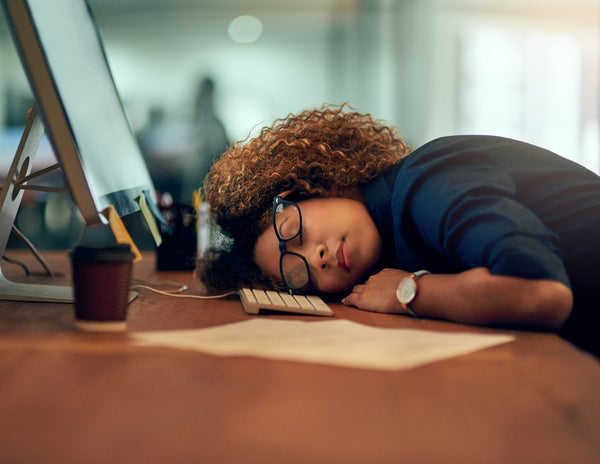
This week, let’s ask the million-dollar question: How much sleep do you really need?
We all know sleep is important. Shakespeare called it the “sore labor’s bath, balm of hurt minds, great nature’s second course, chief nourisher in life’s feast.” Less poetically, headlines these days seem to be shouting: “Sleep deprivation will make you slower and dumber!” “It will give you Alzheimer's disease and heart attacks!” One mattress advertisement I saw simply said, “You can only live seven days without sleep.” Yikes. Talk about pressure to perform!
Fear-mongering aside, there is good evidence that sleep is important for health, well-being, and performance. A recent meta-analysis including over 1600 participants confirmed that sleep restriction is associated with poorer attention and thinking. We’ve known for decades that sleep deprivation disrupts mood. For example, it can trigger manic episodes in those with bipolar disorder. And we’re learning now, from researchers in Sweden and Germany, that insufficient sleep can even affect the microbiota in your gut.
On supporting science journalism
If you're enjoying this article, consider supporting our award-winning journalism by subscribing. By purchasing a subscription you are helping to ensure the future of impactful stories about the discoveries and ideas shaping our world today.
How Much Sleep Is Enough?
But how much sleep is enough? Is there such a thing as too much sleep? If you ask Dr. Google, you’ll get over a billion answers. (That’s right; “billion” with a “b.”) The most common answer seems to be “eight hours.” That seems pretty straightforward. But where does this number come from? And if you’re thinking, “Dr. Google hasn’t examined me; how would she know how much sleep I need,” then you’re asking exactly the right question.
We’ll get to some tips and answers to the deepest sleep mysteries in a moment. But first, consider this:
We’re often told that we should drink eight glasses of water per day. (It seems like eight is a magic number). But does that apply to everyone? I’m a petite couch potato. Do I really need the same amount of water as, say, soccer phenomenon Megan Rapinoe? Does Ruth Bader Ginsberg need the same amount of water as The Rock? Actually, that’s a tough one … with the way she works out at the gym, RBG really might need that much hydration. In any case, how much water she needs to drink depends on her body’s physiology, her current activities, and other factors.
We can apply the same logic to sleep. How much sleep we need depends on how we are biologically hardwired and on our body’s current needs. The National Sleep Foundation’s 2015 guide for healthy sleep durations agrees. To come up with this guide, a panel of sleep experts used the available scientific data to determine appropriate amounts of sleep for each age group.
After much rigorous work, they did not say, “You should get eight hours.” Rather, they said things like, “For teens, we recommend 8 to 10 hours, but anywhere from 7 to 11 hours may be appropriate.” Notice how there is up to a four-hour range in their recommendation—that’s a lot! Also, notice how they specified the age group they were speaking to. For newborn babies, the “may be appropriate” range is from 11 to 18 hours. For seniors over 65, that range is from five to nine hours. The take-away message is two-fold: Not only do healthy sleepers differ from each other in how much sleep they need, but healthy sleepers also change their sleep needs over time.
Now, you may be thinking, “Fair enough. I don’t expect to sleep like a baby and I’m willing to be flexible about the eight-hour rule. But how do I figure out what my own magic number is?” Worry not. This week, I will share 3 tips for figuring out the perfect amount of sleep for you, and for getting the most out of those Zzz’s.
»Continue reading “How Much Sleep Do You Really Need?” on QuickAndDirtyTips.com