
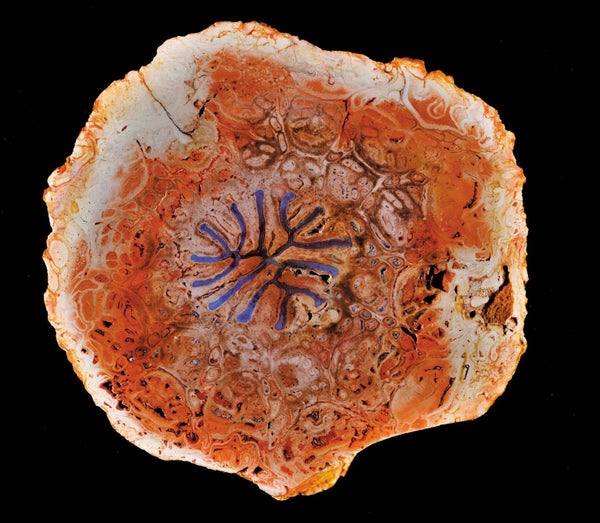
Towering redwoods and lanky jungle vines hoist water from the soil to their lofty leaves through a tubelike tissue called the xylem. In early plants, which reached just a few centimeters and lived only in wet environments, the xylem worked like a simple cylindrical bundle of drinking straws running up the stem; our modern biosphere exists because that infrastructure somehow got much more sophisticated.
The ecosystems “that have been the backdrop for the evolution of life on land weren’t actually there until vascular plants figured out how to grow big in a relatively dry place,” says Czech Academy of Sciences biologist Martin Bouda.
Many modern xylems have intricate cross sections that look like gappy rings, crosses, diamonds or hearts, with dead space called pith separating bundles of xylem tissue. But what nudged plants to remodel their pipes this way is a century-old mystery. Bouda and his colleagues proposed recently in Science that plants developed complex xylems to withstand drought.
On supporting science journalism
If you're enjoying this article, consider supporting our award-winning journalism by subscribing. By purchasing a subscription you are helping to ensure the future of impactful stories about the discoveries and ideas shaping our world today.
Water lost from leaves to dry air cannot be easily replaced from parched soil. Trying to do so strains the xylem, introducing air bubbles that clog the tubes and starve tissues of water—similar to the way that deadly air embolisms cut off animals’ blood flow. Bouda’s team used simulations based on modern and fossil plants to show how modern xylems’ gaps and dead ends hinder such bubbles from spreading.
But smaller-scale tweaks to xylem cells and tissue organization can protect against drought, too, says Cornell University evolutionary biologist Jacob Suissa, who was not involved in the new study. Complex cross sections might have simply arisen incidentally as plants got bigger. “On an evolutionary timescale, size is correlated with increasing complexity,” he says, adding that it’s important to “question the line of thinking that every trait has to be adaptative.”
Suissa suggests that carefully comparing the xylems of plants from different climates could resolve some of the remaining ambiguity.
Nevertheless, the new study highlights the potentially enormous consequences of tiny evolutionary adjustments. Without drought-resistant plant pipes, Bouda says, “it’s hard to imagine what the planet and the species living on it would look like.”