New Issue: Orbital Catastrophe Ahead? Read Now

How the U.S. Lost Years of Life

Many countries saw drops in life expectancy during the pandemic, but some populations have suffered more than others

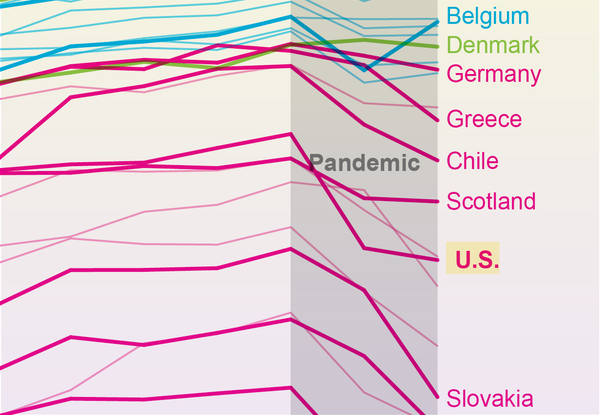
Line chart shows life expectancy at birth since 2015 and how it changed during the pandemic in 29 countries or regions; another line chart breaks down U.S. data by race and ethnicity. Smaller charts compare variations by age and sex in the U.S. versus oth

Amanda Montañez; Sources: “Life Expectancy Changes since COVID-19,” by Jonas Schöley et al., in Nature Human Behaviour. Published online October 17, 2022 (country data); Centers for Disease Control and Prevention (race and ethnicity data)

Join Our Community of Science Lovers!


On supporting science journalism

If you're enjoying this article, consider supporting our award-winning journalism by subscribing. By purchasing a subscription you are helping to ensure the future of impactful stories about the discoveries and ideas shaping our world today.


Over the past century people have been living longer lives around the globe. Then COVID hit. Now, nearly three years into the pandemic, with highly effective vaccines widely available, life expectancy in many middle- and high-income countries has started to bounce back. But in the U.S., it is still dropping. A study last year found that life expectancy in most Western European countries recovered in 2021—most likely the result of high vaccination rates that reduced mortality, particularly among the elderly. But the U.S. has continued to see declines, in part because of lower vaccination rates as well as a devastating opioid epidemic.

Despite being one of the richest countries in the world, the U.S. has seen life expectancy fall to a level not documented since 1996, according to an analysis by the Centers for Disease Control and Prevention. And the effects are not felt equally: Native Americans, Black people, Latino people, and men in general have died at disproportionately high rates during the pandemic, from both COVID and other causes.

Credit: Amanda Montañez; Sources: “Life Expectancy Changes since COVID-19,” by Jonas Schöley et al., in Nature Human Behaviour. Published online October 17, 2022 (country data); Centers for Disease Control and Prevention (race and ethnicity data)

Tanya Lewis was formerly senior desk editor for health and medicine at Scientific American. She wrote and edited stories for the website and print magazine on topics ranging from COVID to organ transplants. She also appeared on Scientific American’s podcast Science Quickly and wrote Scientific American’s weekly Health & Medicine newsletter. She held a number of positions over her nearly 10 years at Scientific American, including health editor, assistant news editor and associate editor at Scientific American Mind. Previously, she has written for outlets that include Insider, Wired, Science News and others. She has a degree in biomedical engineering from Brown University and one in science communication from the University of California, Santa Cruz. Follow her on Bluesky @tanyalewis.bsky.social

More by Tanya Lewis
Scientific American Magazine Vol 328 Issue 2This article was published with the title “How the U.S. Lost Years of Life” in Scientific American Magazine Vol. 328 No. 2 (), p. 76
doi:10.1038/scientificamerican0223-76

Subscribe to Support Independent Journalism

Great science journalism requires human expertise, time, effort and creativity. And it costs money. That’s why I and the journalists here at Scientific American hope you’ll join our community.

When you subscribe, you are supporting staff and freelance journalists who are passionate about telling science stories that are true, important and compelling. Our editors and reporters are often experts in their fields, which means they understand the nuances of big discoveries and can untangle the breakthroughs from the hype. With a subscription, you are also supporting rigorous fact-checking to ensure the words we publish are precise and accurate. And you’re supporting original illustrations, graphics and photos that bring you closer to an advanced laboratory, an ice sheet in Antarctica or a space mission in orbit. You’re helping us craft other types of high-quality journalism as well: Our newsletters are carefully written, edited and curated by staffers you have or will come to know and love. Our Science Quickly podcast is based on original reporting, collaboration with editors and scientists and exacting production.

Subscriptions keep this engine running so we can continue to deliver thoughtful, rigorous and independent science journalism to you. In an era of viral misinformation, this work is crucial. If you value what we do, I hope you’ll consider joining us as a subscriber

Thank you,

Jeanna Bryner, Editor in Chief, Scientific American

Subscribe