
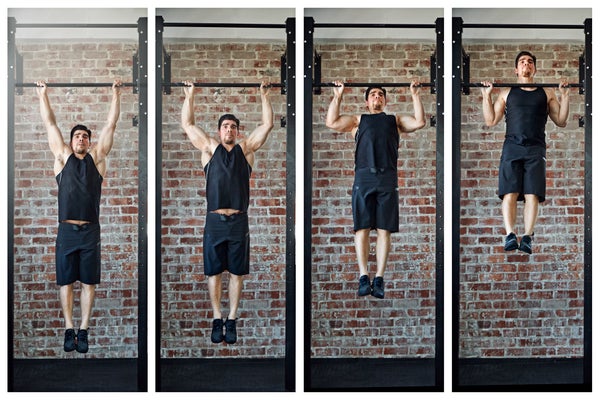

As much as I enjoy my exercise time, I don’t want to burn all of my daylight hours at the gym. I’ll bet you’re the same. So, when I am interested in building some muscle, I prefer to perform a push-pull strength training workout. This strategy gives me, and many of my clients, muscular and strength results in a lot less time.
What is a push-pull workout?
On supporting science journalism
If you're enjoying this article, consider supporting our award-winning journalism by subscribing. By purchasing a subscription you are helping to ensure the future of impactful stories about the discoveries and ideas shaping our world today.
In a nutshell, a push-pull workout is one where you choose a single muscle or muscle group and perform a set of exercises that use those muscles in a pushing direction. Then—either immediately or during your next workout session—you focus on that same muscle or muscle group, but you move in a pulling direction.
Sound complicated? It’s not. Keep reading and you’ll understand.
Reasons to love push-pull training
In the classic muscle-building technique, you typically exercise a single muscle group each day. For example, you’ll dedicate one day to your back, followed by leg, chest, arm, shoulder, and core days. It’s effective, but it can be tedious, and it requires a lot more time at the gym.
Another reason why I like the push-pull workout over the classic technique is that when I categorize my chosen exercises between whether they engage pushing or pulling muscles, it really does make building a full workout easy.
I also don’t have to just sit there on the weight bench staring at the clock on the wall while I give the different muscle groups their prescribed amount of rest between sets. Instead, I’ll tire out the push muscles but then let them rest while I am engaging the pull muscles.
Sure, there’s some cross-over between muscle groups, but when I find that I’m not quite ready for the pull set after finishing a particularly punishing push set, I take a quick 30-second rest to get myself ready again.
Another big advantage is that if you happen to do this workout in a busy gym, you can easily choose, on-the-fly, which set of exercises to do next based on the machine or device currently available. That is, as long as you’re able to keep the push-pull balance intact.
The push-pull plan also allows you to use something called microcycles. With microcycles, during one session, you can use heavier weights for more strength-style training. Then, for the next session, you choose lighter weights but complete a higher amount of reps for a more hypertrophy (muscle building) workout. By using the microcycles, you can get the best of both worlds—strength, and size.
If you’re new to strength training, you’ll likely find that adding a push-pull workout into your exercise regimen makes it easier to plan a routine. Instead of having to remember which muscles are your quads or your delts, or figure out how to target your triceps, you simply need to make a quick assessment. Decide whether a part of your body—arm, leg, back, chest, and so on—is pushing or pulling a weight, and you’re good to go.
As I already hinted, this type of workout is very time-efficient. So, if you find it difficult to build the time into your day to get a good workout done, this exercise pattern will allow you to maximize every minute. The time-saving aspect of this workout is achieved by doing something referred to as a superset. Let’s take a look.