
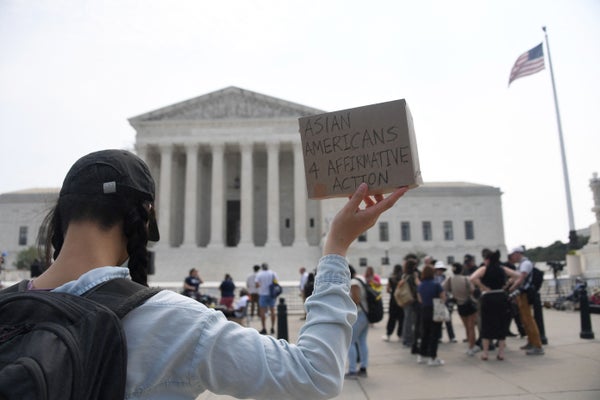
On June 29, the Supreme Court essentially ended affirmative action that considers race in higher education admissions (while exempting military academies), holding that the programs in question at Harvard College and the University of North Carolina “violate the Equal Protection Clause of the Fourteenth Amendment.” The Court’s ruling in both Students for Fair Admissions (SFFA) cases said that Harvard’s and UNC’s admission programs “lack sufficiently focused and measurable objectives warranting the use of race, unavoidably employ race in a negative manner, involve racial stereotyping, and lack meaningful end points,” and are therefore constitutionally impermissible.
However, higher education’s fight for, and commitment to, educational diversity and equity did not begin with the Supreme Court. It will not end with it.
We are affirmative action scholars and colleagues who have studied these issues for years. One of us, Nguyen, co-authored amicus briefs focused on how Asian Americans have been inaccurately and stereotypically portrayed in the Harvard case. The other, Stulberg, is co-writing a book on the origins of race-conscious affirmative action in college admissions. We have learned that race-conscious affirmative action—a small, affirmative, holistic consideration of race at the point of admission among already-qualified applicants—has been a long-standing constitutionally permissible tool that schools have used to enhance the racial diversity of their student bodies. It also provides significant educational benefits to learning, complex thinking and student persistence, among many others.
On supporting science journalism
If you're enjoying this article, consider supporting our award-winning journalism by subscribing. By purchasing a subscription you are helping to ensure the future of impactful stories about the discoveries and ideas shaping our world today.
Losing affirmative action will greatly diminish the ability of colleges and universities to enroll students of color from underrepresented communities. Take the University of California after Proposition 209 as an example, where, on every U.C. campus, “the proportion of freshman applications, admittees, and enrollees from underrepresented minority groups declined precipitously.” The inability to consider race in college admissions moves us further into a race-evasive society— where the impacts of race and racism are real, but where we are unable to respond to them in our public policies and programs.
In the policy’s absence, colleges and universities must still be proactive in widening educational opportunity. They must not stop working toward eliminating racial inequality in higher education. Empirical research must guide our future actions.
Because so much of the focus on affirmative action has been about race as a factor, people may think that is the only form. But affirmative action means affirmatively considering some aspect of group membership, including legacy status, which the court decision left intact. And many people link the start of affirmative action in admissions with the well-known decision in the 1978 Supreme Court case of Regents of the University of California v. Bakke. In that case, the Court established that educational diversity was of sufficient compelling state interest to allow a constitutional use of racial classification in admissions. But the concern for educational diversity, even racial diversity, in higher education began well before Bakke.
The white men who led many of the most elite colleges and universities in the U.S. were inspired by the civil rights movement to use their institutions to contribute to, and even lead on, racial progress. They understood that providing educational opportunities to students who had been historically denied them would require more than just opening campus gates or assuming “color blindness” in the admissions process. So, as early as 1963, university officials began to take race affirmatively into account, in a small and narrow way. The Bakke ruling was simply the first High Court assessment of its constitutionality. It was the first in a series of Supreme Court rulings on the legality of the policy and the supposed unfairness of considering race in an effort to achieve a more diverse student body.
Conservative activist Edward Blum, the founder of SFFA, has dedicated his life to establishing a “color-blind” American society by filing lawsuits with the goal of dismantling civil rights laws and policies such as voting rights, redistricting and affirmative action. In this vein, SFFA exploited our nation’s deep misunderstanding of Asian Americans and pitted different groups of color against each other, in order to end the use of race in college admissions and benefit white and wealthy applicants.
Blum and his allies have inaccurately cast Asian Americans as victims of affirmative action, when that simply isn’t the case. SFFA’s claims reinforce the model minority myth, a harmful stereotype in which Asian Americans are perceived as a monolithic group that is higher achieving and values education more than other racial groups, especially Black, Indigenous and Latinx students. This myth disregards social, historical and public policy factors that drive academic achievement for some Asian Americans, while completely ignoring the educational challenges faced by other Asian Americans, such as Southeast Asian Americans.
For example, selective immigration policies are a key factor in explaining higher test scores among some groups of Asian Americans. Indeed, the “hyper-selecti[on]” of certain Asian immigrants explains why the typical immigrant from China is much more likely to have a college degree than both the average U.S. resident and the average resident in China. However, and importantly, test scores should not occupy such a large determinative factor in the public imagination as to who is qualified for selective college admissions, given that they are much more highly associated with socioeconomic status and family educational attainment than predictors of college success.
Now that our tools in diversifying higher education are constrained, institutions of higher education will need to turn to other ways to maintain their moral and civil rights obligations to not only continue but expand educational equity, access, opportunity and success for students of color.
Off campus, actions include expanding engagement with underserved students and communities in order to develop and expand educational pipelines, including with race-conscious recruitment, scholarships and programming. On campus, admission offices need to take a more holistic approach and place less weight on test scores. College leaders should develop initiatives that strengthen the campus racial climate through, for example, academic, co-curricular and research opportunities, as students are less likely to apply to and attend institutions where they feel underrepresented.
Since there is no proxy that can account for race, these on- and off-campus actions should be designed in such a manner that they promote students’ full selves—where students’ racial and ethnic identities are validated and valued. Finally, the Court’s decision, notably, does not prevent students of color from uplifting and sharing their lived and racialized experiences in their college admissions essays. Students can and should continue doing so.
The Court has handed us and our colleagues a set of new challenges and rescinded a set of important tools. We have our work cut out for us. As educators, we are committed to diversity, equity, belonging and justice in our classrooms and our campus. Facing the new constraints, we must together reaffirm our commitment to diversity in higher education.
This is an opinion and analysis article, and the views expressed by the author or authors are not necessarily those of Scientific American.