
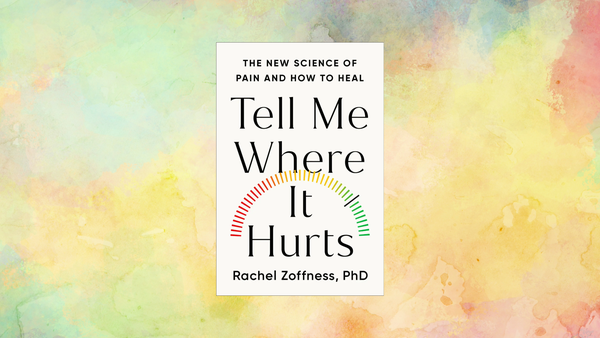
Wearing a cast, taking pain medication and getting a warning to be more careful often puts people on the quickest road to recovery from a broken arm. But that road can be longer when an ailment isn’t as visible—a string of mysterious stomachaches or sporadic painful migraines are more difficult to explain. According to the Centers for Disease Control and Prevention, 24 percent of U.S. adults had chronic pain in 2023. Yet despite how common it is, many doctors and their patients still struggle to be able to simply point to what hurts and fix it. In her new book, Tell Me Where It Hurts: The New Science of Pain and How to Heal, pain scientist and psychologist Rachel Zoffness explores how our bodies feel pain and how we can better understand, and even control, our responses to it.
Scientific American spoke with Zoffness to break down why we feel pain—both acute and chronic—how potential factors drive it and what treatments are emerging.
[An edited transcript of the interview follows.]
On supporting science journalism
If you're enjoying this article, consider supporting our award-winning journalism by subscribing. By purchasing a subscription you are helping to ensure the future of impactful stories about the discoveries and ideas shaping our world today.
You wrote that you started studying pain because you were scared of it. Why?
I think pain is a scary experience. Evolutionarily, it’s supposed to be! Pain is designed to get your attention so that you’ll stop doing what you’re doing and get help and change your behavior so that you don’t die. When I was trying to figure out what I wanted to do with my life, I was taking my first neuroscience class my freshman year, with a neuroscientist named Mark Bear, and he was talking about the science of pain. He explained how it lived at the intersection of medicine, biology, neuroscience, psychology—and I was hooked. I was scared of pain, but it was at the intersection of everything I wanted to do.
You mention in the book that many medical schools don't offer dedicated courses on pain, and those that do often devote just a few hours to it. Why isn’t pain covered in greater depth?
When I started studying pain and I started to understand that it’s biopsychosocial—now my favorite word. This means pain lives in the center of biological factors, psychological factors and sociological factors. When I have pain, I am told to go to the doctor, and they examine the body part that hurts. That’s typically the end of the conversation. Nobody asks me about sleep or diet or stressors or history of trauma, and we have known for decades now that all of those factors affect our pain.
I found out that 96 percent of medical schools in the U.S. have zero required courses dedicated specifically to pain. The 4 percent of medical schools that do have pain education courses are mainly teaching the biomedical model, which is the error that [17th-century French philosopher and scientist] Descartes made in his defining text Meditations on First Philosophy, in which he separated the mind from the body. We have known since the 1965 development of the gate-control theory of pain that pain is more than just your body part that was injured.
You cover a lot of case studies in the book, but the one that jumps to mind is of a young child who lost a limb after a traumatic accident involving fireworks. How did this case study reveal the biopsychosocial factors you’ve focused on?
That was a child named Mateo, and he had terrible phantom limb pain. Phantom limb pain is when someone has terrible pain in a missing body part—he felt like his hand was spasming and clenching all the time, but he had no hand. Pain is ultimately constructed by the brain, and one of the best pieces of evidence neuroscience has for that is phantom limb pain. If you can have terrible arm pain in an arm that is no longer attached to your body, that tells us pretty definitively that pain must be constructed somewhere else. So, if the brain is important, when you have chronic knee pain, the only person you ever see shouldn’t just be the knee specialist.
It’s interesting the way that your book balances making lifestyle changes without saying, “Pain is simply all in your head.” So how do you explain this to people without dismissing their pain?
In the book, I broke down the neuroscience of each biopsychosocial factor. For example, humans are, by design, social animals. When we are social, our brains pump out the neurochemicals that make us feel better, such as dopamine and serotonin and endorphins, which are our natural painkillers. Former U.S. Surgeon General Vivek Murthy did this incredible study of how loneliness is a huge predictor of chronic pain and illness and even a shorter lifespan. So there is science that connects our social health with our physical health.
I wanted to map the biopsychosocial factors out in a way that removed the stigma and emphasize that emotional health, social health and environmental health affect our pain just as much as the biology.
So why does our body bother experiencing such pain, then? What is the evolutionary benefit behind chronic pain, specifically?
Evolutionarily, pain is meant to grab our attention and save our lives. When it comes to acute pain, we want to listen to danger messages, like if you have sudden terrible abdominal pain after eating a bad tuna fish sandwich, you better pay attention to that because you might have food poisoning. One of the ways pain becomes chronic is because of this process called central sensitization. And central sensitization is what it sounds like: “central,” meaning central nervous system, and “sensitization,” meaning it gets more sensitive over time.
Do you have any skill that you were bad at and you practiced it, and over time you got good at it?
Yeah, I, along with everyone else in 2020, decided to learn embroidery.
The pathways in the brain are similar to the muscles in our body. When you use your muscles through exercise, they grow stronger. So the more you embroidered, the stronger the embroidering pathway in your brain became. But so does the pain pathway in our central nervous system; it gets big and strong over time with practice and use. When that happens, we say that our central nervous system has become sensitive to pain.
But among the general public, the phrase “being sensitive to pain” has more broadly carried a lot of stigma and misunderstanding. My goal in life is to explain pain with a lot of hope.