
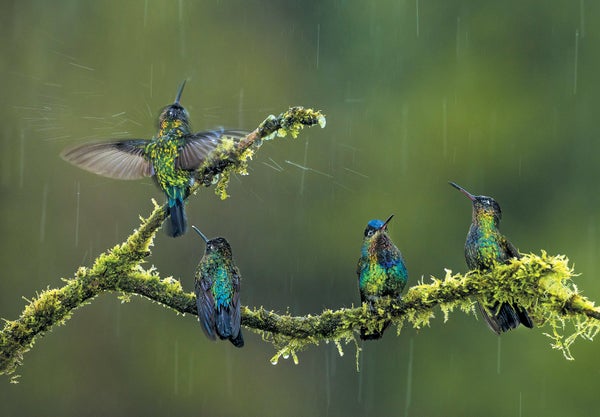
During their nightly energy-conserving cooldowns, hummingbirds may strategically adjust just how low their body temperatures go. These tiny powerhouses cool off by up to 37 degrees Celsius while roosting, entering a hibernationlike state called deep torpor. This state can save 60 to 90 percent of an individual’s energy per hour, says Anusha Shankar, a Cornell University ecologist and lead author of a new study about the phenomenon.
Though crucial for the fleet fliers’ way of life, deep torpor comes with trade-offs. For example, torpid birds become stiff and unable to respond to threats. “They’re effectively comatose,” says University of New Mexico ornithologist Christopher Witt, who was not part of the study.
Now, as detailed in the Journal of Experimental Biology, Shankar’s team shows that some hummingbirds also chill in a shallower torpor with intermediate temperatures, demonstrating more control over their bodies’ thermostats than previously thought.
On supporting science journalism
If you're enjoying this article, consider supporting our award-winning journalism by subscribing. By purchasing a subscription you are helping to ensure the future of impactful stories about the discoveries and ideas shaping our world today.
This capability has gone unnoticed despite 70 years of research on hummingbird torpor, Shankar says. But past research typically examined torpor under laboratory conditions; Shankar, who was then working at Stony Brook University, and her colleagues studied wild hummingbirds in their natural environment in southeastern Arizona.
The scientists captured hummingbirds before nightfall and placed them in outdoor structures. As each night unfolded the team spied on the animals using infrared cameras and charted temperatures around the birds’ eyes, where feathers interfere less with such measurements. The three species studied spent five to 35 percent of the night in shallow torpor. The rest of the time was spent at normal temperatures, in deep torpor, or transitioning between states, with variations from bird to bird. This is the first scientific documentation of shallow torpor in hummingbirds, Witt says, “but it’s very clearly part of their thermal regulatory strategy.”
Shallow torpor may help hummingbirds achieve more of the restorative benefits of sleep while avoiding some potential deep torpor dangers—including reduced immune function—that have been observed in other animals, Shankar says. “And it leads to so many other questions” that she and others are starting to pursue, such as what drives changes in torpor and how the birds accomplish these dramatic temperature shifts.