
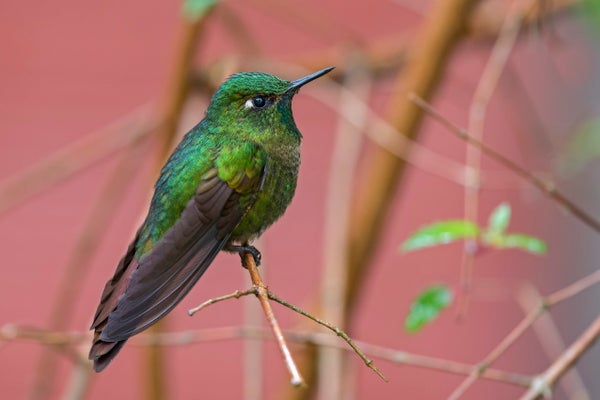

If a hummingbird has ever visited your garden, you’ve no doubt seen it flit from flower to flower, hovering midair as it sips on nectar. That activity requires plenty of energy. So hummingbirds need a lot of nectar to feed their hungry metabolisms.
“In fact, some of them probably drink two or three times their body mass in nectar each day.”
Andrew McKechnie, an ornithologist at the University of Pretoria in South Africa.
On supporting science journalism
If you're enjoying this article, consider supporting our award-winning journalism by subscribing. By purchasing a subscription you are helping to ensure the future of impactful stories about the discoveries and ideas shaping our world today.
McKechnie and his colleagues have studied hummingbirds at extreme elevations in the Peruvian Andes. To survive there, the tiny birds have developed a few tricks. For one, their blood cells are unusually efficient at transporting oxygen. Also, it’s more difficult to hover in the high-altitude thin air. And so ...
“The hummingbirds at those high elevations are much more prone to perching while they feed. And that does seem to be one way they try and reduce energy expenditure.”
Now McKechnie and his colleagues have found another energy-saving adaptation: the high-mountain hummingbirds can lower their body temperature by extreme amounts at night—going into a state called torpor.
“For all intents and appearances, they’re essentially dead. They’re that unresponsive.”
The scientists caught six species of Andean hummingbirds and monitored their temperatures through the night and day. And they found that all six species could enter some type of torpor—they lower their body temperatures from about 100 degrees Fahrenheit by day to as low as 38 degrees Fahrenheit at night. And being “essentially dead” conserves energy.
The details are in the journal Biology Letters. [Blair O. Wolf et al., Extreme and variable torpor among high-elevation Andean hummingbird species]
Although some of the birds’ low body temperatures are on par with those of hibernating mammals, it’s important to note that this isn’t full-fledged hibernation—which is a longer-term response. True hibernation has only ever been documented in one bird, so far at least: the common poorwill in the U.S. Southwest.
“One of my career goals is to find a second hibernating bird.”
And the Andes, he says, is going to be the first place he looks.
—Christopher Intagliata
[The above text is a transcript of this podcast.]
