
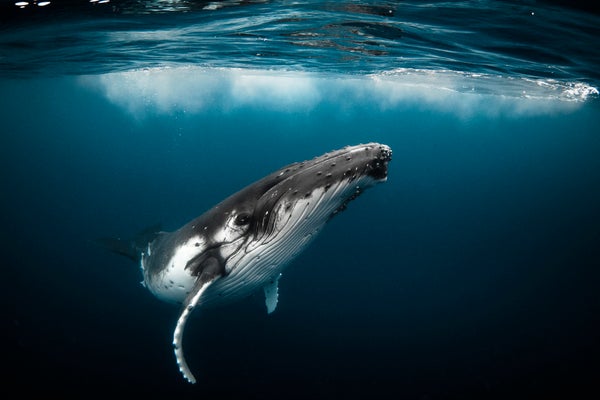
When humpback whales eat, they often open their massive jaws to scoop up huge mouthfuls of water, filled with krill or small fish, before they filter out the excess liquid through their baleen plates, which act like a colander. But according to new research, some humpback whales may be “gaping”—leaving their mouth wide open—even when food isn’t present. It’s unclear what’s driving the mysterious behavior—but researchers have some guesses.
“Just when we think we know a lot about humpback whales, we don’t,” said Vanessa Pirotta, lead author of the study and a lecturer at Macquarie University in Australia, in a statement.
To better understand the “gaping” phenomenon, researchers analyzed 66 videos and photographs of whales with their mouth hanging open that were taken from boats, drones, and in the water and posted to social media between 2014 and 2025. The scientists defined “gaping” as a whale opening its mouth outside of a feeding event, with “variations in both the extent of the gape and its duration.”
On supporting science journalism
If you're enjoying this article, consider supporting our award-winning journalism by subscribing. By purchasing a subscription you are helping to ensure the future of impactful stories about the discoveries and ideas shaping our world today.
The findings were recently published in the journal Animal Behavior and Cognition.
Pirotta and her team don’t know why the whales are gaping, but they do offer some hypotheses: The creatures may be playing, socializing, cleaning their baleen or reacting to a jaw dislocation. Or they might be stretching their mouth.
The results indicate that social media may be a useful tool for identifying rare behaviors in humpback whales and marine mammals more broadly, according to the researchers.
“Tourism operators and citizen scientists spend hours observing whales and are a powerful resource for capturing and reporting on [behavior], using the increasingly high-quality technologies many of us have on hand,” Pirotta said in the statement.