In 2020, Record-Breaking Hurricanes Arrived Early—and Often

A record 30 storms have formed, compared to the previous high of 28; almost all were the earliest on record

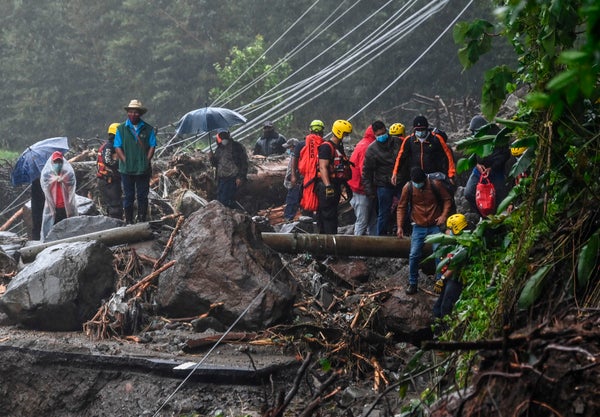
Members of the Red Cross help evacuate people after the overflow of Bambito River because of the heavy rains caused by Hurricane Eta on November 5, 2020.

Join Our Community of Science Lovers!

Editor’s Note (12/1/20): This story has been updated to include the two additional storms that formed during hurricane season, which officially ended yesterday. The 2020 season set a record of 30 named storms.

The 2020 Atlantic hurricane season has truly been one for the record books. With 30 named storms, it has set the record for the most named storms in a single season. (Named storms are those that reach at least tropical storm strength, meaning they have wind speeds of 39 miles per hour or higher.) Forecasters already used up this year’s official storm name list, just as they did in 2005, which means they had to move to the supplementary Greek alphabet. Those two years are the only ones in which this has ever happened.

Of the 30 storms that have formed so far this year, 27 were the earliest of their storm sequence to do so. The graphic below shows how many days earlier in the year each storm formed than the previous record holder; many storms in the latter group occurred in 2005. (The first two storms of 2020, which occurred before the official start of hurricane season, did not set records.) Hurricane Eta, the 28th storm of 2020, first became a tropical storm a whopping two months before Tropical Storm Zeta became the 28th storm of 2005. (The mismatch in names happened because when researchers looked back over records from 2005, they found a mid-season storm that was missed at the time.)

The 2020 season has been an active one in part because of very warm ocean waters that provide fertile ground for hurricanes to grow. As the oceans absorb more and more of the excess heat trapped by greenhouse gases, waters will get warmer earlier in the season, which could help set new records in the future.

Credit: Amanda Montañez; Sources: Phil Klotzbach; National Oceanic and Atmospheric Administration

Andrea Thompson is senior desk editor for life science at Scientific American, covering the environment, energy and earth sciences. She has been covering these issues for nearly two decades. Prior to joining Scientific American, she was a senior writer covering climate science at Climate Central and a reporter and editor at Live Science, where she primarily covered earth science and the environment. She has moderated panels, including as part of the United Nations Sustainable Development Media Zone, and appeared in radio and television interviews on major networks. She holds a graduate degree in science, health and environmental reporting from New York University, as well as a B.S. and an M.S. in atmospheric chemistry from the Georgia Institute of Technology. Follow Thompson on Bluesky @andreatweather.bsky.social

More by Andrea Thompson

Amanda Montañez is senior graphics editor and been at Scientific American since 2015. She produces and art directs information graphics for the Scientific American website and print magazine. Montañez has a bachelor's degree in studio art from Smith College and a master's in biomedical communications from the University of Toronto. Before starting in journalism, she worked as a freelance medical illustrator. Follow her on Bluesky @unamandita.bsky.social

More by Amanda Montañez

It’s Time to Stand Up for Science

If you enjoyed this article, I’d like to ask for your support. Scientific American has served as an advocate for science and industry for 180 years, and right now may be the most critical moment in that two-century history.

I’ve been a Scientific American subscriber since I was 12 years old, and it helped shape the way I look at the world. SciAm always educates and delights me, and inspires a sense of awe for our vast, beautiful universe. I hope it does that for you, too.

If you subscribe to Scientific American, you help ensure that our coverage is centered on meaningful research and discovery; that we have the resources to report on the decisions that threaten labs across the U.S.; and that we support both budding and working scientists at a time when the value of science itself too often goes unrecognized.

In return, you get essential news, captivating podcasts, brilliant infographics, can't-miss newsletters, must-watch videos, challenging games, and the science world's best writing and reporting. You can even gift someone a subscription.

There has never been a more important time for us to stand up and show why science matters. I hope you’ll support us in that mission.

Thank you,

David M. Ewalt, Editor in Chief, Scientific American

Subscribe