
This month, my Scientific American column posed a question about art these days: Should we, the public, be allowed to know how much of it is human talent, and how much was assisted by technology? (I was thinking of, for example, Automatic mode on cameras, or Autotune, or GarageBand, which can produce finished, fully orchestrated songs even if you don’t know anything about music.)
But what about lip syncing? Do we care when a singer is faking it? Does it depend on whether it’s a Broadway show, a live opera, or a rock concert? Are we more forgiving when the singer is also dancing athletically?
Here’s how history answers.
On supporting science journalism
If you're enjoying this article, consider supporting our award-winning journalism by subscribing. By purchasing a subscription you are helping to ensure the future of impactful stories about the discoveries and ideas shaping our world today.
July 21, 1989. Rap duo Milli Vanilli is performing live in Bristol, CT, when their prerecorded vocal track gets stuck on one line (“Girl, you know it’s—“) and keeps repeating. Upon investigation, it’s discovered that the two performers didn’t sing any of the songs on the album for which they’d won a Grammy. Their Grammy is stripped from them, and they became the subjects of 27 lawsuits.
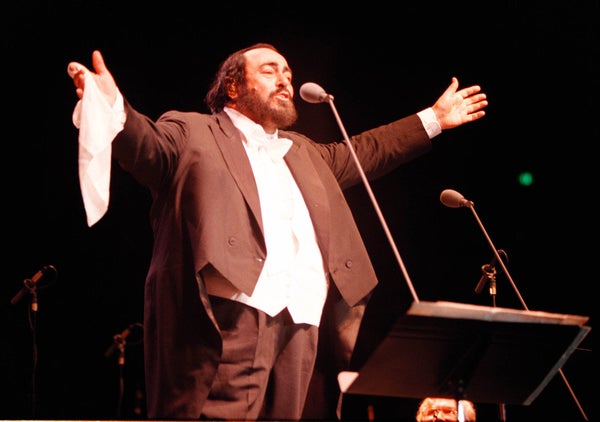
September 27, 1992. Pop stars aren’t the only lip syncers. Legendary operatic tenor Luciano Pavarotti famously sang to a tape at his concert in Modena, Italy, causing outrage among the audience—and the BBC, which had bought the rights to the concert and demanded some of its money back.
July 1, 2006. Ashlee Simpson, performing live on “Saturday Night Live,” doesn’t even bring the microphone to her lips before the audience heard her voice begin the song. She didn’t even pretend to sing; she literally started dancing a jig, and then walked off stage. (She later said that her band was playing “the wrong song”—but didn’t explain why she didn’t intend to sing live on a live show.
January 22, 2009. Singers aren’t the only ones who fake it. At Obama’s first inauguration, Yo-Yo Ma (cello) and Itzhak Perlman (violin) performed to a recording of themselves—because of the extreme cold on the day of the event, spokespeople said later.
Sept 29, 2012. Justin Bieber, performing “live” in Glendale, Arizona as part of his “Believe” tour. He was at the front of the stage when nausea struck him. He turned his back to the audience and threw up—but his vocals continued without him. He’d been lip syncing the whole time.
December 31, 2016. Mariah Carey, live onstage in Times Square on New Year’s Eve, can’t hear her backing track in her earpiece. Her dancers keep dancing, but she doesn’t sing, instead walking the stage and ad libbing to the audience. But the backing track contains a few prerecorded vocals—of Mariah’s famous high-register licks, suggesting that she wasn’t planning to sing them live.
Whitney Houston, Shakira, Hillary Duff, Selena Gomez, Beyoncé, and Jennifer Lopez have all been similarly caught lip syncing in “live” concerts.
Maybe audience shouldn’t be surprised anymore. Maybe we should be satisfied with canned recordings, faked live.
Yet there’s a reason we go to see a live singer: We don’t know the outcome. It’s more exciting. Anything can happen. (Just ask Idina Menzel, who went famously off pitch on the high note of “Let It Go,” during her televised Times Square New Year’s Eve performance in 2014. Well, at least she wasn’t singing to a track.)
As New York Times music critic Bernard Holland wrote after the Pavarotti incident in 1992, “People don’t want to be two-timed. Everything we do in life is geared to cause and effect, and when Mr. Pavarotti opens his mouth, we insist on not knowing what will come out. Public performance is more of a sporting event than we like to admit. We talk about beauty, but we all keep score.”