
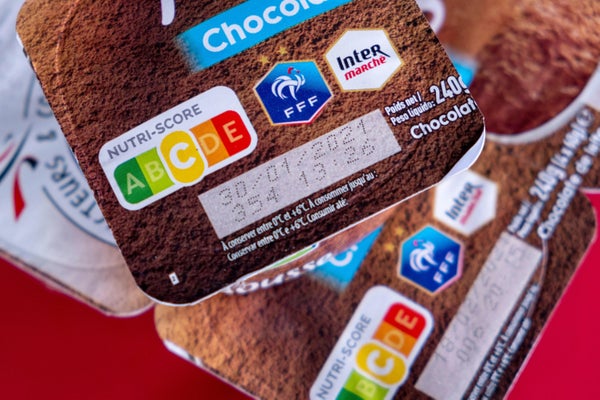
Today’s grocery store aisles are overflowing with “healthy,” “whole grain” and “all natural” treats and snacks. But when you take a closer look at the nutrition facts and ingredients, some of these foods are actually packed with sugar, fat, salt or artificial flavors. To crack down on misleading claims, lawmakers recently introduced legislation called the Food Labeling Modernization Act of 2021, which would require and standardize a front-of-package labeling system that tells consumers if a product is healthy—or if it is not.
The labeling system would include an easily recognizable symbol that rates foods on healthiness. One option is a traffic light icon: the idea might be to make the light red if the food was full of sugars and fats, for example, green if it was low-fat and full of vitamins and yellow if it was in between. Another system suggested in the bill would use stars: think five stars for a fiber-rich, low-calorie granola and one star for an artificially sweetened and colored cereal. If the product contained lots of saturated or trans fats, sodium or added sugars, there would be an additional warning on the label.
The bill includes further requirements for claims of certain ingredients. Any food item with the term “whole grain” on its packaging would have to clarify the actual percentage of whole-grain content. Products that said they contained fruits or vegetables—even those that just had images of an apple or tomato on their label—would have to clarify how much of these ingredients they included. These labels, the bill stipulates, would be standardized in how they looked and where they were located on a food’s package, bag or box.
On supporting science journalism
If you're enjoying this article, consider supporting our award-winning journalism by subscribing. By purchasing a subscription you are helping to ensure the future of impactful stories about the discoveries and ideas shaping our world today.
Supermarket shoppers are no doubt familiar with back-of-package nutrition-fact labels—those black-and-white boxes that declare how many calories, grams of sugar or milligrams of cholesterol, and quantities of other nutrients are contained within one serving. The U.S. Food and Drug Administration required and standardized these labels in 1990 to better inform the public, but they do not always drive consumers to pick one food over another, says Jayson Lusk, an agricultural economist at Purdue University. A notification on the front can be more obvious and persuasive. “Research does suggest that front-of-pack labels have more impact on consumer choice than standard nutrition-fact labels,” he says.
But there are pros and cons to such markers, Lusk explains. For one, some research shows that people do not always respond to them predictably. “You might see that a product has ‘low sodium’ but that might signal to people, ‘This tastes bad’” and dissuade them from purchasing it, he says. Another con is the difficulty in creating a one-size-fits-all definition. “People have very nuanced and conflicting perspectives on what ‘healthy’ means,” Lusk says. Plus, there is limited real estate on the front of a packaged food, Lusk points out, so exactly how the labels would look and fit might impact their efficacy.
The meaning of symbols might also get lost in a supermarket, which is often a chaotic and overstimulating place even for the savviest, most nutrition-conscious consumer, says David Just, an agricultural economist at Cornell University. Shoppers are “just looking for the gist of [whether] something is healthy or unhealthy,” he says. Busy, multitasking people do not always have the time or bandwidth to read and consider complicated labels on the front of every product they throw in their cart, Just says. Most of that decision-making happens on a knee-jerk level, he explains.
That said, Just thinks the new bill does address a real problem “and could perhaps have a positive influence.” Some countries in Europe have put stoplight labels on foods to grade them on their healthiness, similar to the new bill’s proposal, he says. “We’re not the only country dealing with this,” Just says. In 2016 Chile passed a law mandating front-of-package warning labels. Although that requirement’s direct effects on metrics such as obesity are not yet clear, some companies reformulated their products, taking sugar, salt or saturated fats out of their recipes to avoid warning labels. Just and Lusk both point to successful efforts within independent grocery stores to implement stoplight or star systems that grade foods on nutritional value. “When we’ve seen simple systems like this put in place, it generally causes a pretty positive impact on shoppers who are a little less engaged in nutrition,” Just says.
The Food Labeling Modernization Act, introduced by Representative Frank Pallone, Jr., of New Jersey on August 3, was assigned to the House Committee on Energy and Commerce for study and review. Congress is now in summer recess (though the House of Representatives recently returned early for a potential vote on a $3.5-trillion budget resolution), and no further action has been scheduled for the food labeling legislation yet.