
Do you have a favorite place to go where you can see the Milky Way? I can't see it from my house, but if I trespass on a nearby public golf course (shh), I can get a good look at our galaxy, as well as any comets that are just visible to the naked eye. Have you ever looked at Saturn or Jupiter through binoculars and seen their moons? You can see them if you keep your hands steady enough and if—if, if, if—the sky is dark enough.
We've made a lot of progress in the U.S. and much of the world in reducing smog and water pollution. Environmental regulations have brought back the bald eagle and are slowly healing the ozone hole. When we understand a problem and work together, we can solve it. And now it's time to solve light pollution.
Astronomers raised the alarm about light pollution—they, like anybody looking up through wobbly binoculars, need dark skies to get a good look at the rest of the universe. Biologists have discovered that light disrupts wildlife in profound ways. Excess light is a waste of energy, and light pollution might harm human health. As science writer Joshua Sokol describes, smart, science-based policies and better lighting technology can reduce wasted light and let all of us enjoy the sparkling night sky.
On supporting science journalism
If you're enjoying this article, consider supporting our award-winning journalism by subscribing. By purchasing a subscription you are helping to ensure the future of impactful stories about the discoveries and ideas shaping our world today.
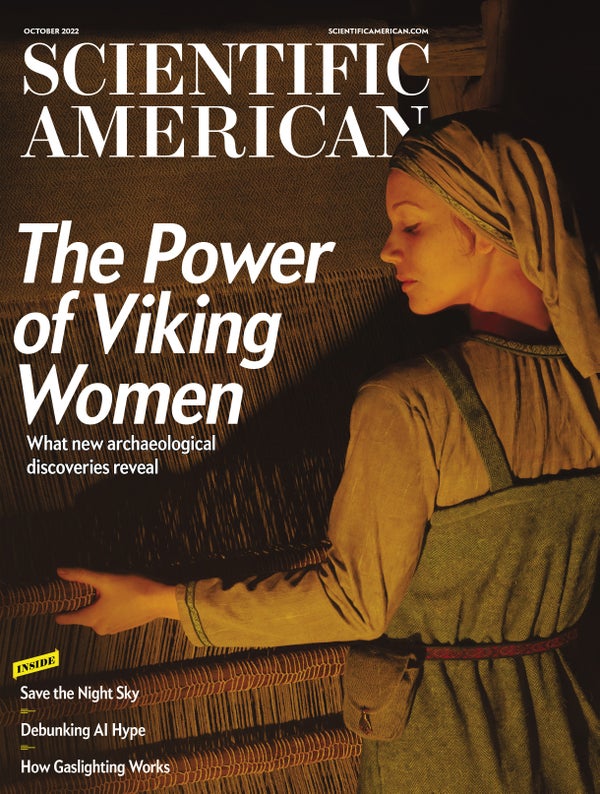
Archaeology is having a reckoning, realizing that many of the stories the field has spun out of cultural remains have missed half of past cultures. Research on Vikings has focused on conquest and sailing and tools and wars, which are all fascinating, but only recently have researchers sought to understand work dominated by women in Iceland and Greenland. In this month's cover story, journalist Francine Russo shows how the women's expertise in creating textiles boosted the North Atlantic economy during Viking and medieval times—they literally made the money.
Recognizing patterns is one of the things that humans can generally still do better than algorithms. Mathematician Kelsey Houston-Edwards details how algorithms based on topology, or “squishy math,” can help identify patterns in all kinds of data, including doughnuts (well, torus-shaped maps) in the brain.
For more reassurance that artificial intelligence is not going to replace human intelligence, at least not yet, author Gary Marcus deflates the hype bubble around impressive new AIs. These algorithms seem to know what they're talking about, until you ask the right questions.
The term “gaslighting” comes from a play from the 1930s that was made into a film starring Ingrid Bergman. It has become widespread lately to depict a type of psychological abuse that makes victims doubt their own grasp of reality. Sociologist Paige L. Sweet shares her research into the social structures and relationship patterns that give gaslighting its often devastating power.
Photographer Alastair Philip Wiper takes us inside one of the most advanced fusion research sites: the U.S. National Ignition Facility in Livermore, Calif. As journalist Adam Mann explains, this is where scientists conduct experiments to gauge the status of the nuclear stockpile. It's a chilling reminder that we still have more than enough nuclear weapons to destroy the world and that this would be a good time to resume negotiations for nuclear arms control.