
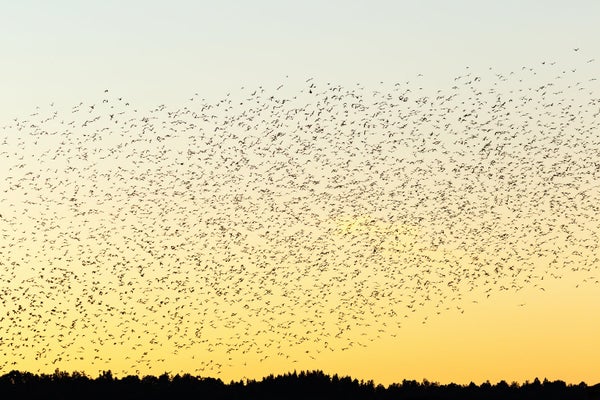
Jackdaws switch between two sets of flocking rules with differing results, a new research has found. Flocks flying to winter roosts are orderly no matter how many birds they contain; those rallying to ward off predators are initially disorganized when their numbers are small and then suddenly flip to order once enough birds join in.
Swimming bacteria, marching locusts, schooling fish and flocking birds all function as cohesive units. This phenomenon can emerge when individual agents following identical rules come together, says Alex Thornton, who studies cognitive evolution at the University of Exeter in England. “We got used to thinking of collective behavior as this almost physical phenomenon,” he says. “So the idea that animals might actually change the rules that they use when their environment and what they're trying to achieve are different is quite novel and exciting.” Thornton is co-author on the new work, detailed last November in Nature Communications.
The researchers filmed flocking wild jackdaws in Cornwall, England, with four synchronized high-speed cameras, charting individuals' positions and trajectories.
On supporting science journalism
If you're enjoying this article, consider supporting our award-winning journalism by subscribing. By purchasing a subscription you are helping to ensure the future of impactful stories about the discoveries and ideas shaping our world today.
Of the 16 flocks recorded, six were “transit flocks”—jackdaws returning to their roosts on winter evenings. In these groups, regardless of size, each jackdaw adjusted its trajectory based on a fixed number of neighbors and always maintained order.
To initiate “mobbing flocks,” the researchers presented to groups of jackdaws a taxidermy fox holding a fake, flapping bird and played alarm calls that the birds commonly use to recruit allies against predators. In this context, jackdaws instead navigated by tracking all birds that were within a fixed distance. “With these [predator-mobbing] rules, you have emergence of order from chaos,” Thornton says. “Small flocks are disorganized. When the density of the flock reaches a threshold level, suddenly there is order—much like how a gas transitions into a liquid.” These transitions have never been observed in birds before, he adds.
“The novelty comes in comparing the same species in different ecological contexts, which [the researchers] implemented via a clever technique,” says Shashi Thutupalli, who studies living systems' self-organization at India's National Center for Biological Sciences and who was not involved in the research. He wonders whether “influencers” in a flock might lead these adjustments and whether other species make similar behavioral switches.
“What our work shows is that you cannot ignore the external environment in trying to model collective behavior in biological systems,” says Nicholas Ouellette, a physicist at Stanford University and co-author on the study. Drawing inspiration from jackdaws, he says, engineers could someday use context-dependent responses to build fleets of drones that work together for firefighting, surveying and search-and-rescue missions: “It allows you to think about designing systems that are more flexible, that can change the rules to make the behavior more robust.”