
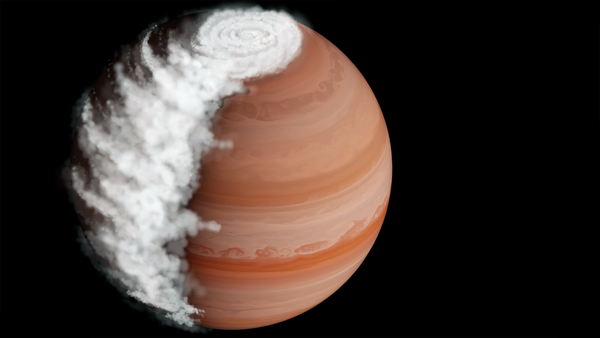
Nearly 700 light-years from Earth, morning clouds make way for a clear night on the exoplanet WASP-94A b. Scientists discovered this gas giant more than a decade ago, but new observations from NASA’s James Webb Space Telescope (JWST) offer this weird world’s first-ever weather report.
Like most known exoplanets, WASP-94A b is too distant for current telescopes to directly image, but astronomers have still managed to learn a lot about this faraway world via more subtle techniques. The gas giant is a “hot Jupiter” that circles its star every four days, inducing a stellar wobble that reveals the planet’s mass and orbital period. And WASP-94A b’s orbital plane is aligned just so with our solar system so that, every four days, we see it cross the face of its star, casting a planetary shadow that slightly dims the star’s light. Carefully monitoring the star for these “transits” allows astronomers not only to measure WASP-94A b’s size but also to study its composition, sniffing out the presence or absence of various chemicals in its air by gathering spectra from starlight streaming through the gas giant’s upper atmosphere.
Dense starlight-blocking clouds, however, can often obscure such spectral observations. But researchers realized WASP-94A b offered a potential work-around. The planet is held so close by its star that it has become tidally locked, much like the moon around Earth: the exoplanet’s spin and its orbit is synchronized so that the world always turns the same side to its stellar host. This results in eternal day for one half of the planet and eternal night for the other. But it also lets astronomers view the edges of these halves—the leading “morning” side and the trailing “evening” side—separately as WASP-94A b moves around its star.
On supporting science journalism
If you're enjoying this article, consider supporting our award-winning journalism by subscribing. By purchasing a subscription you are helping to ensure the future of impactful stories about the discoveries and ideas shaping our world today.
And somewhat unsurprisingly, JWST’s observations suggest these two halves are extremely different, with the planet’s morning dayside edge overcast with puffy clouds while the nightside’s evening edge is almost cloud-free. These clouds aren’t much like Earth’s fluffy wisps; instead they’re thought to be composed of magnesium silicate, iron and magnesium sulfide—essentially vaporized rock. The results, which should help scientists better understand the atmosphere and weather of WASP-94A b and other hot Jupiters, appear today in the journal Science.
“It was really surprising how different the two halves of the same planet are,” says Sagnick Mukherjee, lead author of the study and a postdoctoral fellow at Arizona State University. “What this tells us is: if we don’t know about the weather cycles on these distant planets, we won’t be able to measure their composition well.”
To explain the drastic disparity in WASP-94A b’s weather patterns, it’s important to remember that while the planet’s dayside and nightside are locked, the resulting hemispheric difference in temperature can drive powerful winds, pushing air around the world. The study authors argue this process leads to clouds forming from cooler air throughout the night before they dissipate in the bright morning light, much like an overnight fog on Earth will burn off as the day progresses.
“It’s just beautifully clear in the data,” says Heather Knutson, an exoplanetary scientist at the California Institute of Technology, who was not involved in the new study. “You can, at a glance, see the difference” in the hemispheres’ weather.
WASP-94A b’s obvious asymmetry offers yet more evidence that, just like Earth, exoplanets can have patchy and dynamic cloud cover. It also highlights the importance of observing multiple regions of a planet before making assumptions about its composition, formation and evolution.
“When we use models that are too simple to interpret our data, we can get tricked into thinking we have the right answer when actually we have the wrong answer,” Knutson says. “We know that many exoplanets have clouds, and clouds really don’t like to be uniform across the whole planet..., so we really need to account for the fact that the atmosphere is not globally the same everywhere.”
The research team has already used JWST to study similar atmospheric dynamics on two other transiting hot Jupiters, WASP-39 b and WASP-17 b. And if technological forecasts hold, more powerful future telescopes could eventually study the weather of smaller, more Earth-like exoplanets as well.