
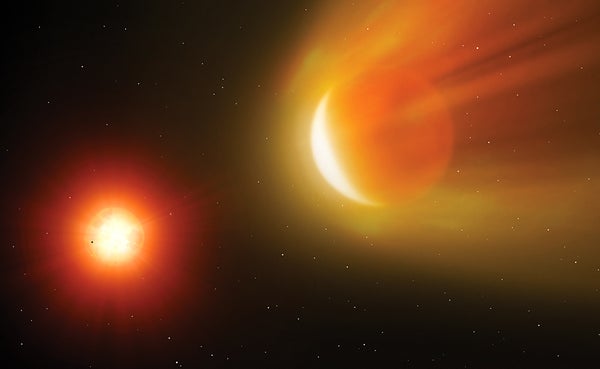
Trillions of miles from Earth, a cluster of planets whirl around a sun of their own—and one of the worlds is a sulfur-swathed oddball. Research suggests the planet, L 98-59 d, would smell like rotten eggs and is covered in a mushy magma ocean. And it isn’t just an outlier in its home solar system. So far it’s the first exoplanet found to fit this peculiar description, and it seems to be defining a category of its own.
Scientists first observed the planet in 2019, when the Transiting Exoplanet Survey Satellite caught a glimpse of L 98-59 d passing in front of the red dwarf star at the center of its system. Afterward, observations from the Hubble and James Webb Space Telescopes hinted at the planet’s composition, but the more scientists learned, the less this newfound orb seemed to fit into existing categories for planets of its size. Neither rocky with a thick hydrogen atmosphere nor an ocean world, L 98-59 d might occupy a new class of molten, sulfurous exoplanet, according to a study in Nature Astronomy.
“It’s pretty hellish, it’s pretty alien,” says Harrison Nicholls, lead author of the study and a postdoctoral researcher at the University of Cambridge. “With more data, we might find that there are other planets like it, too.”
On supporting science journalism
If you're enjoying this article, consider supporting our award-winning journalism by subscribing. By purchasing a subscription you are helping to ensure the future of impactful stories about the discoveries and ideas shaping our world today.
The first confirmed detection of an exoplanet, though long anticipated, was only 34 years ago. Increasingly powerful telescopes have since launched the field forward with more detections—now more than 6,000 in total. But it’s one thing to find an exoplanet and quite another to understand its surface conditions.
Astronomers can gauge the size and mass of far-flung worlds by watching how light dims and wobbles as the planets cross in front of their home stars. They study planets’ composition by measuring the light that passes through their foreign atmospheres. Theorists then bring these wide-ranging worlds to life through cohesive models of the planets’ features and formation. “Even with perfect data, the numbers don’t tell you anything on their own,” Nicholls says. “And we’re limited a little bit by what we can be certain about” with planet L 98-59 d.
Scientists know that the planet is about five billion years old and that its searing surface temperature reaches more than 1,500 degrees Celsius. It’s about 1.6 times the size of Earth, but it has an unusually low density. The strangest feature in the data, however, is its sulfur-rich atmosphere. Many young planets, including early Earth, have a brief “rotten eggs phase” because of intense volcanic activity. But the hydrogen sulfide and sulfur dioxide produced in that period don’t usually stick around for five billion years.
Researchers used computer models to turn back the clock on L 98-59 d and figure out how it could have formed. They found that a disk of material around a star with enough of these volatile components could create a type of planet that’s molten from its sticky surface all the way to its core—and that such planets might be common.
“In general, in science we start by telling very simple stories, and those stories get more elaborate as time goes on [because] we have to explain a wider range of things or more detailed measurements,” says Heather Knutson, a planetary scientist at the California Institute of Technology, who was not involved in the new study. “This is a great example of that.”
Because the field of exoplanet research is so new, there are not yet enough categories to adequately describe the diversity of these bodies. L 98-59 d is a step toward “moving beyond boxes” of discrete planet types—such as ocean or rocky worlds—and establishing a continuum of types that might give insights into how worlds change and evolve, says Julien de Wit, a planetary scientist at the Massachusetts Institute of Technology, who also was not involved in the study.
“Really, the dream of an observer is to construct a classification scheme that then doesn’t just describe the universe; it tells you something new about the universe,” agrees Thomas Beatty, an astronomer at the University of Wisconsin–Madison, who was not part of the study.
Perhaps the best example of such a classification system, Beatty says, is the Hertzsprung-Russell diagram. This scatterplot of stars illuminated the process of stellar evolution and jump-started the field of stellar physics more than a century ago. That work started with simply observing individual stars and sorting them into categories—just like scientists finally have the technology to do with exoplanets today. Some hope that an exoplanet-classification system will similarly help to resolve the unknowns in planetary evolution, such as how the process differs among planet types.
Although studying weird worlds such as L 98-59 d will probably help to clarify how planets evolve, researchers are still working to understand this particular one. A molten magma world best fits the data collected so far, but scientists are observing the exoplanet to eliminate uncertainties—such as how much sulfur is in its atmosphere—that could pin down our understanding of what things are like on the surface of L 98-59 d.
Researchers suggest that we should have an even clearer conception of the planet after another year or two of observation. By then L 98-59 d may not be alone in its proposed new class. “The field is moving so quickly, and we’re learning there’s so much we don’t know,” Nicholls says. “I do think that we have good reason to believe that the sulfur world is probably going to be quite a substantial category of planets.”