
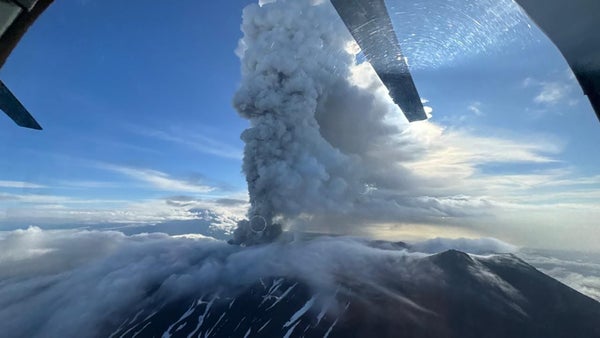
Russia’s Krasheninnikov volcano erupted for the first time in centuries on August 3, sending ash and gas nearly four miles into the atmosphere—less than 150 miles away from the epicenter of the magnitude 8.8 earthquake that struck on July 29.
The mountain is one of eight active volcanoes in the Kronotsky Nature Reserve and part of the Eastern Kamchatka Volcanic Arc. The eruption began around 6 A.M. local time on Sunday (2 P.M. EDT on August 2), when personnel in the area noticed ash, steam and gas escaping from the slopes of the volcano, according to a Russian-language statement posted on the nature reserve’s website.
READ MORE: Why the Russian Earthquake Didn’t Cause a Huge Tsunami
On supporting science journalism
If you're enjoying this article, consider supporting our award-winning journalism by subscribing. By purchasing a subscription you are helping to ensure the future of impactful stories about the discoveries and ideas shaping our world today.
The volcano is located on the sparsely populated Kamchatka Peninsula, just across the international date line from Alaska’s Aleutian Islands. Because of its remote location, the volcano presents little threat to humans. Scientists have cataloged 31 previous confirmed eruptions of Krasheninnikov throughout the current Holocene epoch, which began about 11,700 years ago. Its most recent known eruption occurred around 1550, according to the Smithsonian Institution‘s Global Volcanism Program.
Large earthquakes do occasionally trigger nearby volcanic eruptions, according to the U.S. Geological Survey—but only if the volcano is already nearing an eruption, with enough magma stored inside of it undergoing high enough pressure.
Another volcano in the same arc, Klyuchevskoy, is also currently erupting. Scientists watched lava fill the crater beginning in April and confirmed large amounts of fresh lava there on July 19, before the massive earthquake. This volcano has historically been much more active than Krasheninnikov, with more than 111 Holocene eruptions identified by scientists, including more than a dozen in the past two decades.