Tsunami Warnings Issued after Magnitude 8.8 Earthquake Strikes off Russian Coast

Tsunami warnings and advisories were issued around the Pacific Ocean after a magnitude 8.8 earthquake struck off the coast of Russia, the largest earthquake since the 2011 earthquake and resulting tsunami in Japan

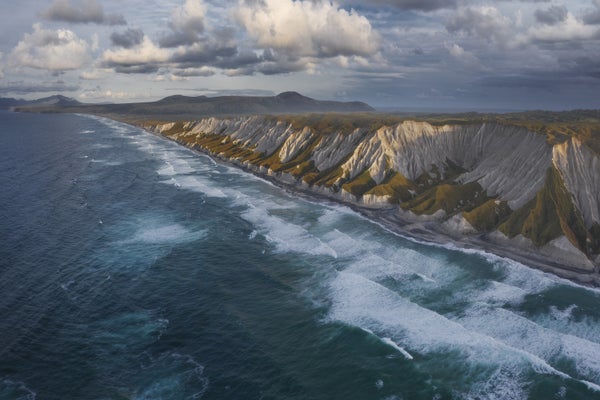
A photo from March 2022 shows an aerial view of South Kuril Islands and coastline in Kamchatka region, Russia.

A photograph from March 2022 shows an aerial view of the South Kuril Islands.

Natalia Zakharova/Anadolu via Getty Images

Join Our Community of Science Lovers!

Tsunami warnings were issued around the Pacific Ocean after a magnitude 8.8 earthquake struck off the coast of Russia’s Kamchatka Peninsula in the late morning local time on July 30. Waves 5.7 feet above normal reached Hawaii, flooding parking lots and streets, and wave heights reached up to eight feet in parts of California, the Guardian reported.

The U.S. Tsunami Warning System has transitioned coastal areas from Hawaii to Alaska to the mainland Pacific Coast to a Tsunami Advisory, which means that “a tsunami with the potential to generate strong currents or waves dangerous to those in or very near the water is imminent, expected, or occurring” but that significant inundation is not expected. Under this advisory, people should stay out of the water and away from beaches and coastal waterways. Officials have cautioned that the first waves to arrive may not be the largest, however, and that there is still risk over the next 24 hours. Surge of some three to 10 feet could still hit areas, including the coast of South America.

READ MORE: Russia’s 8.8 Earthquake Is One of the Strongest Ever Recorded


On supporting science journalism

If you're enjoying this article, consider supporting our award-winning journalism by subscribing. By purchasing a subscription you are helping to ensure the future of impactful stories about the discoveries and ideas shaping our world today.


This earthquake may be the eighth largest on record globally, wrote seismologist Alice-Agnes Gabriel of the Scripps Institution of Oceanography, on Bluesky. It is likely the largest since the 2011 earthquake off the coast of Japan, which triggered a devastating tsunami that killed thousands and caused the disaster at the Fukushima Daiichi nuclear power plant. The magnitude was upgraded from 8.7; a magnitude 8.8 earthquake releases about 40 percent more energy than a magnitude 8.7 one.
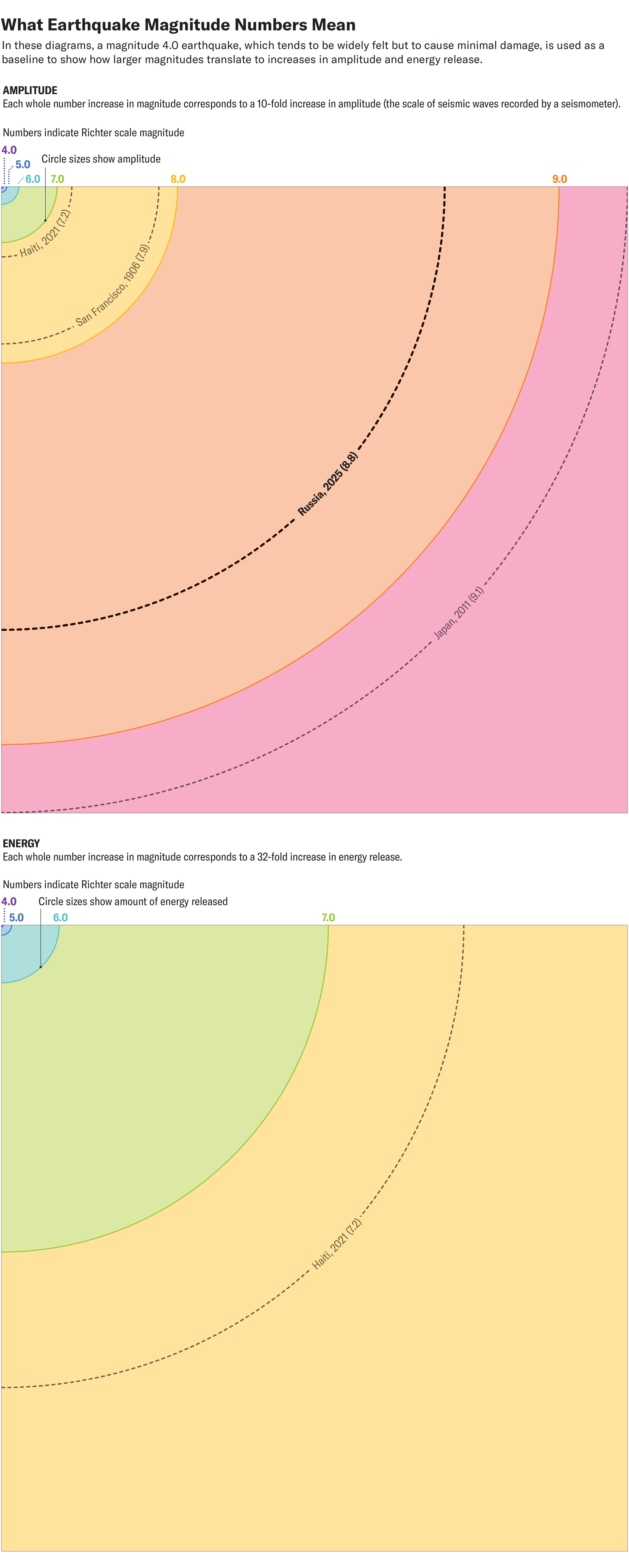
A set of concentric circles cropped within a rectangular frame are scaled to show the amplitude of earthquakes measuring 4.0, 5.0, 6.0, 7.0, 8.0 and 9.0 on the Richter scale. Each whole number increase corresponds to a 10-fold increase in amplitude. A second set of concentric circles cropped within a rectangular frame are scaled to show the energy released by earthquakes measuring 4.0, 5.0, 6.0 and 7.0 on the Richter scale. Each whole number increase corresponds to a 32-fold increase in energy.

Amanda Montañez

Evacuations were initially ordered in Japan and Hawaii after the July 30 earthquake. The first waves had begun to hit Japan around 10 A.M. local time, several hours after the earthquake.

The earthquake happened in a subduction zone at the Kuril-Kamchatka Arc, where the Pacific plate is being subducted under the Okhotsk plate. The epicenter is located 45 kilometers (28 miles) southeast of where a magnitude 9.0 temblor struck in 1952 and caused “a destructive, Pacific-wide tsunami,” according to the U.S. Geological Survey.

A magnitude 7.4 earthquake that struck in the same region on July 20, 2025, was a foreshock to this July 30 quake, the USGS says.

Editor’s Note (7/30/25): This story will be periodically updated to reflect new information as the event unfolds.

Andrea Thompson is senior desk editor for life science at Scientific American, covering the environment, energy and earth sciences. She has been covering these issues for nearly two decades. Prior to joining Scientific American, she was a senior writer covering climate science at Climate Central and a reporter and editor at Live Science, where she primarily covered earth science and the environment. She has moderated panels, including as part of the United Nations Sustainable Development Media Zone, and appeared in radio and television interviews on major networks. She holds a graduate degree in science, health and environmental reporting from New York University, as well as a B.S. and an M.S. in atmospheric chemistry from the Georgia Institute of Technology. Follow Thompson on Bluesky @andreatweather.bsky.social

More by Andrea Thompson

It’s Time to Stand Up for Science

If you enjoyed this article, I’d like to ask for your support. Scientific American has served as an advocate for science and industry for 180 years, and right now may be the most critical moment in that two-century history.

I’ve been a Scientific American subscriber since I was 12 years old, and it helped shape the way I look at the world. SciAm always educates and delights me, and inspires a sense of awe for our vast, beautiful universe. I hope it does that for you, too.

If you subscribe to Scientific American, you help ensure that our coverage is centered on meaningful research and discovery; that we have the resources to report on the decisions that threaten labs across the U.S.; and that we support both budding and working scientists at a time when the value of science itself too often goes unrecognized.

In return, you get essential news, captivating podcasts, brilliant infographics, can't-miss newsletters, must-watch videos, challenging games, and the science world's best writing and reporting. You can even gift someone a subscription.

There has never been a more important time for us to stand up and show why science matters. I hope you’ll support us in that mission.

Thank you,

David M. Ewalt, Editor in Chief, Scientific American

Subscribe