Russia’s 8.8 Earthquake Is One of the Strongest Ever Recorded

Russia’s earthquake was estimated at magnitude 8.8, among the strongest since scientists began monitoring

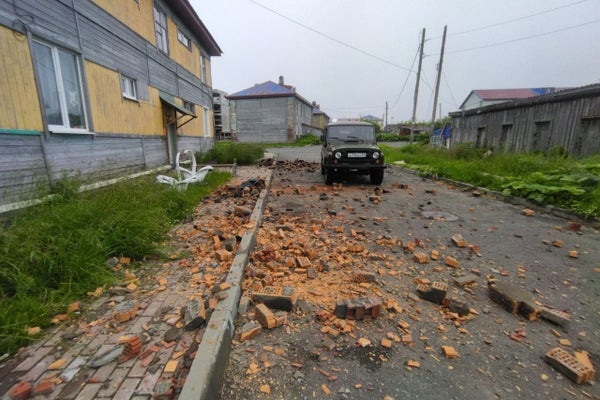
Loose bricks and other earthquake damage

Damage from a magnitude 8.8 earthquake that struck off Russia’s Kamchatka Peninsula on July 30, 2025.

Kamchatka Branch of Geophysical Survey of Russian Academy of Science (KBGSRAS)/S. Lakamov via Getty Images

Join Our Community of Science Lovers!

On July 30, 2025, a magnitude 8.8 earthquake struck off the eastern coast of Russia, sending a tsunami toward that country’s coast and high waves across the Pacific Ocean, from Japan to Hawaii and California. The world has witnessed several very large earthquakes in the past couple of years, including a magnitude 7.7 quake in Myanmar in March 2025 and a magnitude 7.4 temblor on Taiwan’s eastern coast in April 2024. The Richter scale is logarithmic, meaning the seismic waves in a magnitude 8.0 quake are 10 times greater in amplitude than those in a magnitude 7.0 one—and have roughly 32 times more power. The 7.0 waves, in turn, are 10 times greater and 32 times more powerful than those of a 6.0 quake.
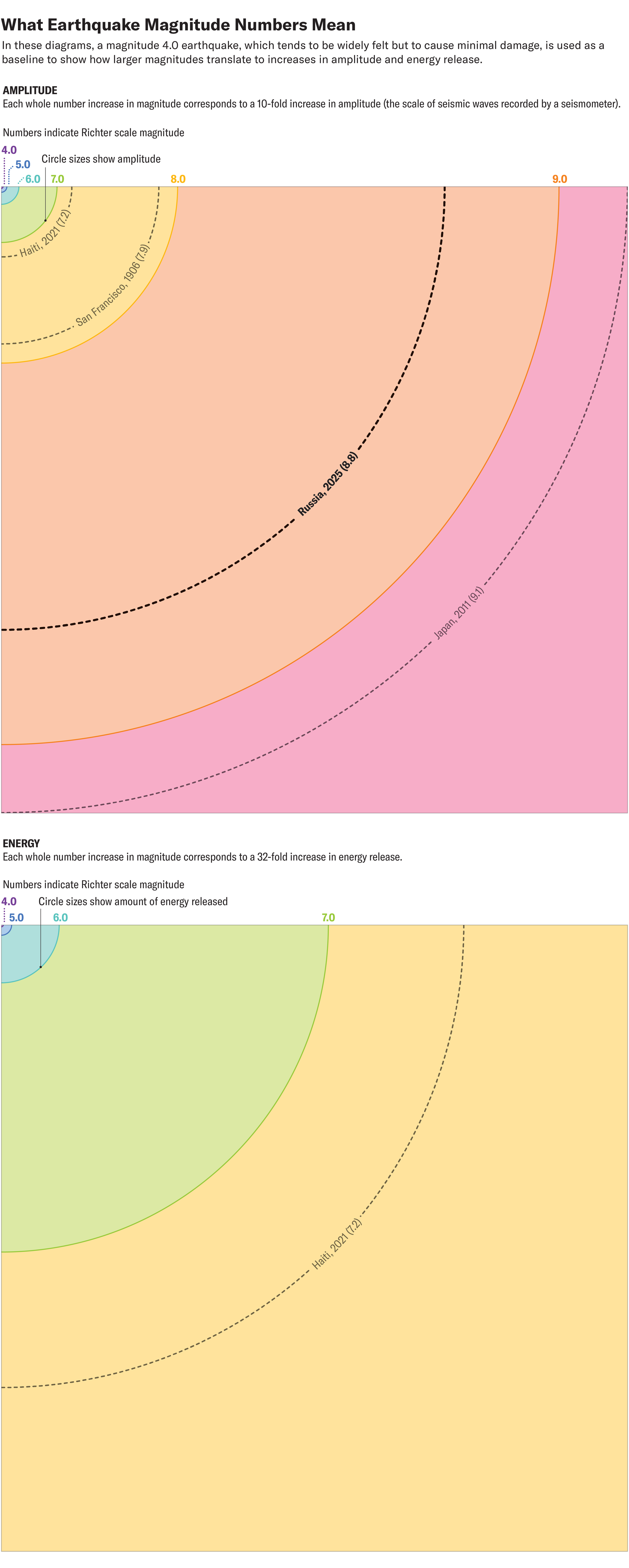
A set of concentric circles cropped within a rectangular frame are scaled to show the amplitude of earthquakes measuring 4.0, 5.0, 6.0, 7.0, 8.0 and 9.0 on the Richter scale. Each whole number increase corresponds to a 10-fold increase in amplitude. A second set of concentric circles cropped within a rectangular frame are scaled to show the energy released by earthquakes measuring 4.0, 5.0, 6.0 and 7.0 on the Richter scale. Each whole number increase corresponds to a 32-fold increase in energy.

Amanda Montañez

READ MORE: Tsunami Warnings Issued after Magnitude 8.8 Earthquake Strikes off Russian Coast


On supporting science journalism

If you're enjoying this article, consider supporting our award-winning journalism by subscribing. By purchasing a subscription you are helping to ensure the future of impactful stories about the discoveries and ideas shaping our world today.


The strongest earthquake ever recorded, a magnitude 9.5, struck Chile’s southern coast in 1960. Below is a list and details of the most powerful earthquakes on record, according to the U.S. Geological Survey. Russia’s latest quake will likely be added after scientists have a chance to analyze and verify data recorded by seismographs worldwide.

Magnitude 9.5: Biobío, Chile, 1960. This earthquake, the largest on record, is often called the Valdivia earthquake or Great Chilean earthquake. It killed 1,655 people and caused two million to become houseless.

Magnitude 9.2: Alaska, 1964. This quake, known as the Great Alaska earthquake, the Prince William Sound earthquake or the Good Friday earthquake, caused a tsunami. Together, the earthquake and tsunami resulted in the deaths of 130 people and $2.3 billion in damage.

Magnitude 9.1: Sumatra, Indonesia, 2004. Called the Sumatra-Andaman Islands earthquake, this quake caused massive tsunamis and more than 280,000 deaths. It also displaced 1.1 million people in South Asia and East Africa.

Magnitude 9.1: Tōhoku, Japan, 2011. The Great Tōhoku earthquake and subsequent tsunami caused more than 15,000 deaths and displaced and additional 130,000 people.

Magnitude 9.0: Kamchatka Krai, Russia, 1952. This earthquake was the first recorded magnitude 9.0 quake in the world and caused a massive tsunami that struck Hawaii, resulting in more than $1 million in damages.

Magnitude 8.8: Biobío, Chile, 2010. This intense quake struck offshore, near Chile’s city of Quirihue. More than 370,000 homes were destroyed, and 523 people were killed.

Magnitude 8.8: Esmeraldas, Ecuador, 1906. A strong tsunami was triggered by the so-called Ecuador-Colombia earthquake. The tsunami traveled as far north as San Francisco and caused 1,500 deaths.

Magnitude 8.7: Alaska, 1965. This earthquake occurred near the Rat Islands, part of the Aleutian Islands in Alaska. The height of the resulting tsunami was reportedly 35 feet.

Magnitude 8.6: Arunachal Pradesh, India, 1960. The Assam-Tibet earthquake killed 780 people. In addition to shaking, the quake caused sandblows, cracks in the ground and landslides.

Magnitude 8.6: Sumatra, Indonesia, 2012. This earthquake struck off the coast of northern Sumatra and resulted in heavy shaking. A few deaths occurred; most were caused by heart attacks.

Mark Fischetti was a senior editor at Scientific American for nearly 20 years and covered sustainability issues, including climate, environment, energy, and more. He assigned and edited feature articles and news by journalists and scientists and also wrote in those formats. He was founding managing editor of two spin-off magazines: Scientific American Mind and Scientific American Earth 3.0. His 2001 article “Drowning New Orleans” predicted the widespread disaster that a storm like Hurricane Katrina would impose on the city. Fischetti has written as a freelancer for the New York Times, Sports Illustrated, Smithsonian and many other outlets. He co-authored the book Weaving the Web with Tim Berners-Lee, inventor of the World Wide Web, which tells the real story of how the Web was created. He also co-authored The New Killer Diseases with microbiologist Elinor Levy. Fischetti has a physics degree and has twice served as Attaway Fellow in Civic Culture at Centenary College of Louisiana, which awarded him an honorary doctorate. In 2021 he received the American Geophysical Union’s Robert C. Cowen Award for Sustained Achievement in Science Journalism. He has appeared on NBC’s Meet the Press, CNN, the History Channel, NPR News and many radio stations.

More by Mark Fischetti

It’s Time to Stand Up for Science

If you enjoyed this article, I’d like to ask for your support. Scientific American has served as an advocate for science and industry for 180 years, and right now may be the most critical moment in that two-century history.

I’ve been a Scientific American subscriber since I was 12 years old, and it helped shape the way I look at the world. SciAm always educates and delights me, and inspires a sense of awe for our vast, beautiful universe. I hope it does that for you, too.

If you subscribe to Scientific American, you help ensure that our coverage is centered on meaningful research and discovery; that we have the resources to report on the decisions that threaten labs across the U.S.; and that we support both budding and working scientists at a time when the value of science itself too often goes unrecognized.

In return, you get essential news, captivating podcasts, brilliant infographics, can't-miss newsletters, must-watch videos, challenging games, and the science world's best writing and reporting. You can even gift someone a subscription.

There has never been a more important time for us to stand up and show why science matters. I hope you’ll support us in that mission.

Thank you,

David M. Ewalt, Editor in Chief, Scientific American

Subscribe