
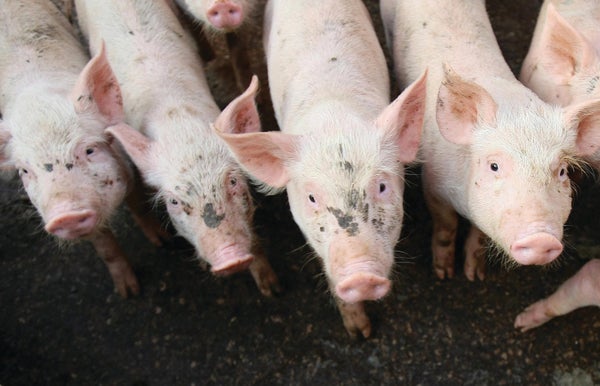
Humans have become a dominant force on the planet, driving species extinctions, transforming the landscape and changing the climate. And this influence will likely outlast Homo sapiens by millions of years: we also look set to dominate paleontology in the distant future, according to research published in March in Anthropocene. The new study finds that mammalian fossils from the current people-centric geologic age will consist almost entirely of humans, livestock and pets.
“We and our animals are just going to totally flood the mammalian fossil record,” says Roy Plotnick, a paleontologist at the University of Illinois at Chicago and lead author of the study. “The future fossil record of today will include lots of human skeletons all lined up in a row.”
The recent research was a natural follow-up to a 2016 paper in which Plotnick and his colleagues examined whether endangered species would wind up in the fossil record. They found that less than 9 percent of mammals currently threatened with extinction will likely make the cut. After learning which fossils would not be present, Plotnick says he was curious to see which would.
On supporting science journalism
If you're enjoying this article, consider supporting our award-winning journalism by subscribing. By purchasing a subscription you are helping to ensure the future of impactful stories about the discoveries and ideas shaping our world today.
So he and co-author Karen Koy, a paleontologist at Missouri Western State University, exhaustively reviewed studies of how the numbers of humans, livestock and wild animals and their distribution have changed over time, both globally and in the state of Michigan. For the latter, they compared cemetery and landfill locations to sites where Pleistocene and Holocene mammalian fossils tend to occur. They also considered how human treatment of remains differs from natural processes.
The researchers found that even as wild animal numbers plummet worldwide, human development is also crowding out marshlands and other places most conducive to fossil-forming processes. Combined with the vast numbers of humans and domesticated animals occupying the planet—96 percent of all mammals’ biomass consists of people and livestock, according to a 2018 study—these findings suggest very low chances of wild animals being represented in the fossil record.* (Plotnick and Koy also predict cats and dogs will likely be preserved, based on their geographical spread.) And future fossils will probably look much different from most found today. For example, they will include sawed animal bones from industrial-scale meat processing, complete and aligned human skeletons in cemeteries, and mass assemblages of livestock carcasses in landfills.
These changes’ sheer scale is “staggering,” says Kate Lyons, a paleoecologist at the University of Nebraska–Lincoln, who was not involved in the new research. “As I was reading the paper, I was thinking sadly of all the ecological questions that I am able to ask using the Pleistocene fossil record that will be unanswerable using this future fossil record.”
*Editor’s Note (5/15/20): This sentence has been revised after posting to correct the reference to people and livestock making up 96 percent of all mammals’ biomass.