
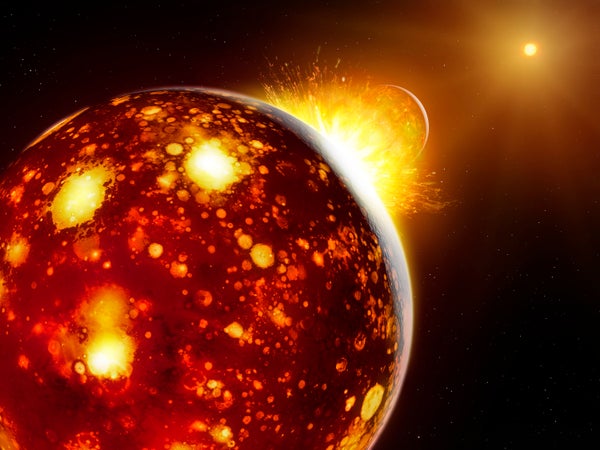
Roughly four and a half billion years ago the planet Theia slammed into Earth, destroying itself, melting large portions of our planet’s mantle and ejecting a huge debris disk that later pulled together to become the moon. Scientists have long wondered about both the composition and the origin of Theia. Now they have evidence that it formed very close to home.
The original giant-impact model of the moon’s formation, proposed in the 1970s, predicted that the moon was made mostly of material from the colliding object. This scenario implied there should be differences between the chemical compositions of the moon and Earth, but research has found that the two are nearly identical—far more similar than two independent planetary bodies should be. A study published recently in Science took a close look at other things Theia gave us besides the moon: additional molybdenum and iron left behind on Earth from the collision.
Ancient Earth would have accumulated these heavy elements in its core but not in the rocky mantle closer to the surface, so any iron present now in Earth’s mantle most likely came from Theia. Thus, it can tell us about that planet’s composition, says study co-author Thorsten Kleine, director of the planetary science department of the Max Planck Institute for Solar System Research in Germany.
On supporting science journalism
If you're enjoying this article, consider supporting our award-winning journalism by subscribing. By purchasing a subscription you are helping to ensure the future of impactful stories about the discoveries and ideas shaping our world today.
Kleine and his colleagues analyzed 15 terrestrial rocks and six lunar samples brought to Earth by Apollo missions. They focused first on iron isotopes: variations of the element with different numbers of neutrons. Rocks and planets in the solar system share nearly identical distributions of these isotopes, but in the past few years Kleine and some of his co-authors discovered that certain tiny deviations from the standard iron isotope ratio can reveal the sample’s place of origin. “The discovery of iron isotope anomalies is relatively recent, which I guess is why no one has done it for the moon so far,” Kleine says. “These analyses are difficult, and the variations are small, so it is not an easy experiment to do.” The team combined the data on iron with isotope distributions of molybdenum and zirconium found in the same samples to reverse engineer Theia’s likely size and composition. The researchers also compared the measurements with those of samples from 20 meteorites, some of which originated in the inner solar system and some in the outer, to determine Theia’s place of origin.
The new study reveals Theia as a rocky planet with a metallic core that most likely had a mass 5 to 10 percent of Earth’s and that formed in the inner solar system, closer than Earth to the sun. This picture lines up with previous hypotheses for why the bodies seemed to have so much in common, Kleine says; what we didn’t know was exactly where Theia originated.
Back in 2020 Kleine and other scientists demonstrated that celestial bodies that formed closer to the sun are richer in heavy elements. Following this principle, Kleine and his co-authors estimated that Earth has a bit more molybdenum and zirconium than it should, and they figured these additional heavy elements must have been brought here by Theia. They combined those data with what they had learned about the iron.
Planetary scientist Sara Russell, a senior research lead at the Natural History Museum, London, who was not involved in the new findings, praises the exceptional precision of the authors’ iron measurements. For her, the study’s implications go beyond just the origins of Theia—they offer insights into the conditions that eventually shaped the Earth-moon system into a cradle of life. “This careful work and insightful modeling help us better understand our origins,” she says.
The team hasn’t yet run simulations of the giant impact based on this proposed scenario, Kleine says, but he looks forward to doing so and to analyzing lunar samples to look for other element isotopes.
Russell hopes future sample-return missions can boost this type of analysis. “I find it amazing we are still learning new things about the moon and Earth more than 50 years since the Apollo astronauts collected these rocks from the lunar surface,” Russell says. “Collecting samples in space and bringing them to curate on Earth means we can make much more detailed measurements than are possible in space and preserve them for future generations to make their own discoveries.”