
For decades, scientists have been baffled by two large, mysterious blobs in Earth’s mantle. These rock formations are thousands of kilometres long and slightly denser than their surroundings, hinting that they are made of different material than the rest of the mantle.
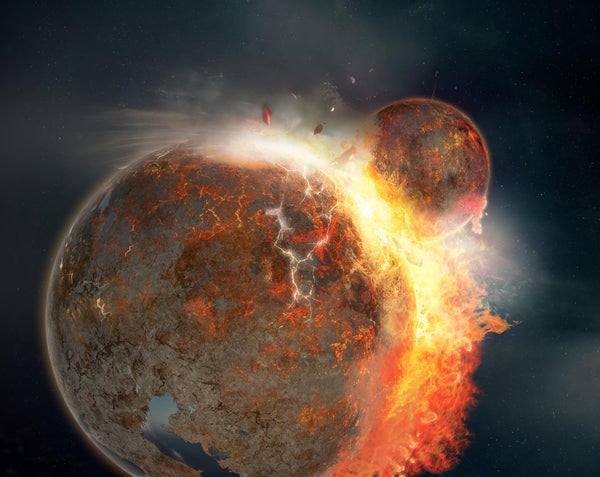
New computer modelling supports a dramatic origin story for these strange blobs: they are artefacts of a gargantuan collision 4.5 billion years ago between early Earth and another young planet — the same collision thought to have formed the Moon. The modelling suggests that this violent encounter caused material from the impacting world, called Theia, to embed itself in the lower half of Earth’s mantle. The collision also caused some of Theia’s remnants to be flung into orbit; these eventually coalesced into the Moon.
The idea that the mantle anomalies are remnants of Theia is not new, says Robin Canup, a planetary scientist at the Southwest Research Institute in Boulder, Colorado. “But this paper is the first in my mind to really take that notion seriously,” she says.
On supporting science journalism
If you're enjoying this article, consider supporting our award-winning journalism by subscribing. By purchasing a subscription you are helping to ensure the future of impactful stories about the discoveries and ideas shaping our world today.
The study appears today in Nature.
Cosmic collision
A giant collision between the young Earth and a smaller protoplanet has long been the prevailing theory for the Moon’s formation. Such an origin would explain features such as the Moon’s lack of many volatile compounds, which would have been vapourized during the collision with Earth.
Such an enormous impact early in Earth’s development should have left some traces. Yuan and his colleagues wondered whether those traces might include the strange regions in Earth’s mantle — the layer between the crust and the core. Scientists call these formations large low-velocity provinces, because seismic waves travel more slowly through them than they do through the rest of the mantle.
The researchers ran computer simulations of the interaction between Theia’s mantle and that of Earth from the moment of the collision to the present. This showed that some material from Theia initially sank to the bottom portion of Earth’s mantle and that more of Theia piled up there over time, forming the blobs. The authors reported these results at a planetary-science meeting in 2021.
For their latest work, the authors expanded their models. They found that the energy of the planetary smash-up would have partially melted Earth’s mantle, which would then have had two layers: a molten top and a mostly solid bottom.
The upper, molten layer would have swirled some Theia material into Earth material. But other Theia material would have sunk through the molten portion of the mantle and lodged itself in the bottom layer. Eventually it would have formed two separate blobs. Meanwhile, other Theia material was launched into orbit and formed the Moon.
Comparing mantle and Moon
The model isn’t a smoking gun that the mantle anomalies are remnants of Theia, but Yuan and his colleagues have “made a case that [the scenario] can be taken seriously,” Canup says. “It’s not just a throwaway idea, which is kind of what I think [it] was before this work.” The next step will be validating the models by comparing rock samples from the mantle with some from the Moon.
Maxim Ballmer, a geodynamicist at University College London, is not sure that this idea for the mantle anomalies will hold up. The model “definitely needs to be tested,” Ballmer says. “But I do think that it’s an idea worth pursuing.”
Yuan hopes that this and subsequent research could shed light on what has made Earth so unique — factors that might include the collision with Theia. This study, he says, suggests that “this giant impact [created] some heterogeneities in the Earth that can last for billions of years.”
This article is reproduced with permission and was first published on November 1, 2023.