
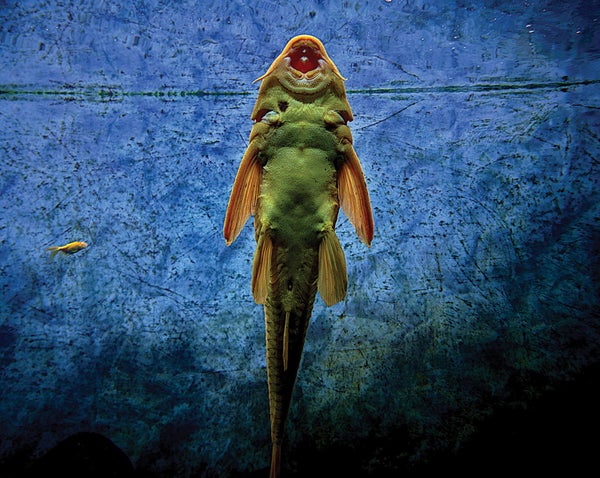
“Devilfish” catfish, also called suckermouths, are native to South America but have spread to four other continents. These freshwater invaders outcompete native species and eat their eggs, even damaging fisheries. But in Scientific Reports, researchers in Mexico showed the pests could be unexpectedly useful: when ground into a paste, they can help filter ceramics industry wastewater.
The ceramic tile sector alone produces at least 16 billion square meters of product a year. Manufacturing facilities go through large quantities of potable water, and a biological cleaning system like this one could allow reuse instead of letting that water drain away.
Collagen from the fish's connective tissues, when combined with an iron-rich salt, works as a coagulant: the mix destabilizes tiny bits of waste compounds so they amass into bigger globs that can be strained out. The scientists found this process removed 94 percent of solids from industrial ceramics wastewater, and it reduced an indicator of organic materials in the water by 79 percent. The researchers say their fish mix is less toxic than other available coagulants—a toxicity that discourages some manufacturers from filtering ceramic waste at all.
On supporting science journalism
If you're enjoying this article, consider supporting our award-winning journalism by subscribing. By purchasing a subscription you are helping to ensure the future of impactful stories about the discoveries and ideas shaping our world today.
“Most of the time ceramic waste is left to dry in the sun, and later the mud is disposed of or used as fill material,” says environmental scientist Miguel Mauricio Aguilera Flores of the National Polytechnic Institute of Mexico, who led the study. “People mistrust reusing the water in any of their activities because of fears of toxicity arising from currently available chemical coagulants, so at present the water resource is lost.”
The mixture is simple to prepare, but Aguilera Flores says getting enough biomass for industrial use might be a limiting factor. Trapping wild devilfish could support modest demand, he says, but to scale up, they might ultimately need to be farmed—carefully.
“Effluent management from any industry is a serious issue, and the ceramic manufacturing industry is no exception,” says Eileen De Guire, technical content and communications director at the American Ceramic Society. “Taking advantage of an invasive species seems to be a creative way to use one waste problem to solve another.”