
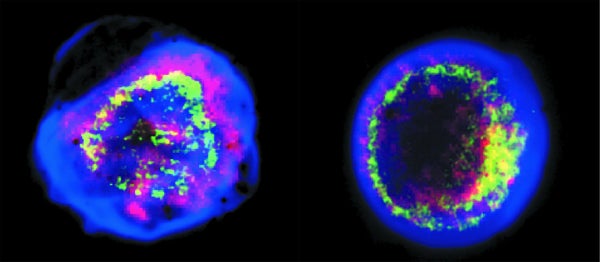
When a dense stellar core called a white dwarf acquires enough material from a companion star orbiting nearby, it burns up in the nuclear fusion blast of a Type Ia supernova. This ejects freshly synthesized elements that mix with interstellar gas and eventually form stars and galaxies. But astrophysicists still don't know the specific conditions that ignite these explosions.
Ivo Seitenzahl, an astrophysicist at University of New South Wales Canberra, and his colleagues used the upgraded Very Large Telescope (VLT) in Chile to build unprecedented 3-D chemical maps of the debris left behind by these supernovae. These maps can help scientists work backward to “constrain the fundamental properties of these explosions, including the amount of kinetic energy and the mass of the exploding star,” says Carles Badenes, an astrophysicist at the University of Pittsburgh, who was not involved in the study.
During a supernova event, heavy elements shoot from the white dwarf's core at supersonic speeds. This drives a shock wave outward through the surrounding interstellar gas and dust, and another shock wave bounces backward into the explosion debris, eventually heating the ejected matter to x-ray-emitting temperatures. Scientists can learn about a supernova remnant's composition from these x-rays—but current x-ray instruments lack the resolution to measure the movement of ejected material.
On supporting science journalism
If you're enjoying this article, consider supporting our award-winning journalism by subscribing. By purchasing a subscription you are helping to ensure the future of impactful stories about the discoveries and ideas shaping our world today.
Seitenzahl's group used visible-light data from the VLT to analyze supernova remnants in a new way, described in July in Physical Review Letters. Basic models suggest that Type Ia supernovae produce most of the universe's iron. That iron should hold a stronger electrical charge the farther it is behind the supernova's shock wave and emit distinctive visible wavelengths of light; however, those emissions were too faint to detect before the VLT's recent instrument upgrade.
With the upgrade, the researchers detected concentric layers of charged iron within supernova remnants in the Large Magellanic Cloud, a nearby satellite galaxy of our Milky Way. From distortion patterns in light released by the charged iron, they determined the inward shock wave's velocity in Type Ia supernova remnants for the first time. “This is exciting science that's been enabled by new technology, used on precisely the type of [supernova] that needs it,” says Dan Milisavljevic, an astronomer at Purdue University, who was also not involved in the work.
Seitenzahl's group also found that one particular supernova originated from a white dwarf whose mass was thought to be too small to trigger such an explosion, suggesting there is still more to learn about this process. Further work could reveal more details about the chemicals produced in Type Ia supernovae, whether an explosion initiates on the surface or interior of the star and what conditions trigger the blast.