
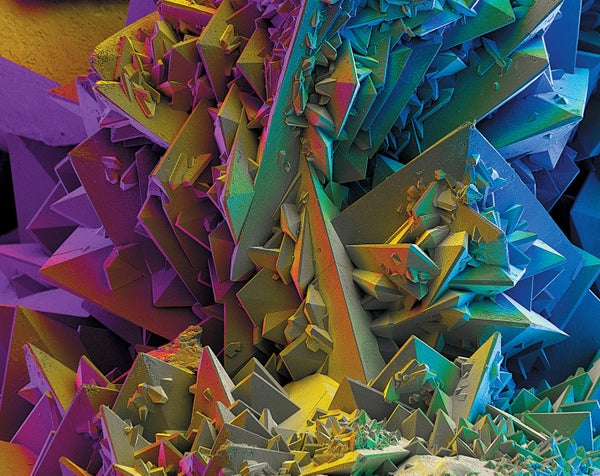
In searching for potential dangers humans would face on a long Mars mission, scientists are leaving no stone unturned—including the ones that show up at weirdly high rates in astronauts’ kidneys.
Healthy kidneys filter blood to balance the body’s water, salts and minerals, expelling waste as urine. When this process goes awry, painful kidney stones—hard accumulations of salts and materials such as calcium—can form in this essential organ. Researchers have theorized that astronauts are prone to kidney stones because bones degrade faster in microgravity, increasing calcium levels in the blood. But these stones’ surprising frequency among space travelers even years after they return to Earth suggests other factors are involved.
To investigate, the authors of a recent study in Nature Communications explored how microgravity and galactic cosmic radiation affect kidney function—particularly parts of the kidney called tubules, which help to maintain healthy salt and mineral levels. The team analyzed data from astronauts in space and from rodents both in space and on the ground: those in space experience the combined impact of microgravity and radiation forces, and ground-based experiments let the scientists isolate the effects of each.
On supporting science journalism
If you're enjoying this article, consider supporting our award-winning journalism by subscribing. By purchasing a subscription you are helping to ensure the future of impactful stories about the discoveries and ideas shaping our world today.
Kidneys are exceptionally responsive and adaptable—but these traits can work against them. When microgravity shifts the body’s distribution of internal fluids, kidney tubules tend to shrink; this action hinders the organ’s ability to properly filter calcium and salts, increasing the risk of kidney stones and other health issues. And diminished tubules are more vulnerable to high-energy cosmic rays. “There’s an unholy alliance between microgravity and galactic radiation,” says study lead author Keith Siew, a kidney physiologist at University College London.
Microgravity’s effects may be reversible back on Earth. But radiation is “like a bowling ball where you grab it and throw it” at the body’s cells, says Evagelia Laiakis, a radiotherapy researcher at Georgetown University. “You’re going to damage DNA, proteins and organelles,” possibly causing permanent injury. Outside Earth’s protective atmosphere, a high-energy particle stream bombards and decommissions power-generating mitochondria while disrupting key protein-production processes. And tubular remodeling caused by microgravity may stiffen vital blood vessels, increasing their susceptibility to radiation-induced inflammation and tissue damage.
Siew says these daunting results may even underestimate the risks of damage to astronauts’ kidneys. More research is urgently needed into how to strengthen spacecraft shields meant to scatter incoming radiation, he adds.
“This is a gateway study,” says Matthew Bailey, a kidney physiologist at the University of Edinburgh. The results could help illuminate kidney disease mechanisms on Earth, and they could suggest more effective ways to protect organs from radiation—allowing for expanded radiotherapy against cancer.
“We are restless explorers; there’s no question we’re going [to Mars],” Bailey adds. “But most people don’t think of the needed health research to make it possible.”