
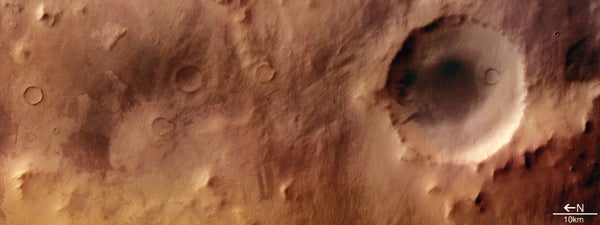
Deep below the ground, radioactive elements disintegrate water molecules, producing ingredients that can fuel subterranean life. This process, known as radiolysis, has sustained bacteria in isolated, water-filled cracks and rock pores on Earth for millions to billions of years. Now a study published in Astrobiology contends that radiolysis could have powered microbial life in the Martian subsurface.
Dust storms, cosmic rays and solar winds ravage the Red Planet’s surface. But belowground, some life might find refuge. “The environment with the best chance of habitability on Mars is the subsurface,” says Jesse Tarnas, a planetary scientist at NASA’s Jet Propulsion Laboratory and the new study’s lead author. Examining the Martian underground could help scientists learn whether life could have survived there—and the best subsurface samples available today are Martian meteorites that have crash-landed on Earth.
Tarnas and his colleagues evaluated the grain sizes, mineral makeup and radioactive element abundance in Martian meteorites and estimated the Martian crust’s porosity using satellite and rover data. They plugged these attributes into a computer model that simulated radiolysis to see how efficiently the process would have generated hydrogen gas and sulfates: chemical ingredients that can power the metabolism of underground bacteria. The researchers report that if water was present, radiolysis in the Martian subsurface could have sustained microbial communities for billions of years—and perhaps still could today.
On supporting science journalism
If you're enjoying this article, consider supporting our award-winning journalism by subscribing. By purchasing a subscription you are helping to ensure the future of impactful stories about the discoveries and ideas shaping our world today.
Scientists have previously studied Mars radiolysis, but this marks the first estimate using Martian rocks to quantify the planet’s subsurface habitability. Tarnas and his colleagues also evaluated the potential richness of life in the Martian underground and found that as many as a million microbes could exist in a kilogram of rock. (Geobiologists have found comparable densities in Earth’s subsurface.)
The most habitable meteorite samples analyzed appeared to be made of a rock type called regolith breccia. “These are thought to come from the southern highlands of Mars, which is the most ancient terrain on Mars,” Tarnas says.
Underground life, as described by this research, would require water—and it remains unknown if groundwater exists on the planet, says Lujendra Ojha, a planetary scientist at Rutgers University, who was not involved in the study. Determining whether the Martian crust contains water will be an important next step, but this investigation helps to motivate that search, Ojha says: “Where there is groundwater, there could be life.”