
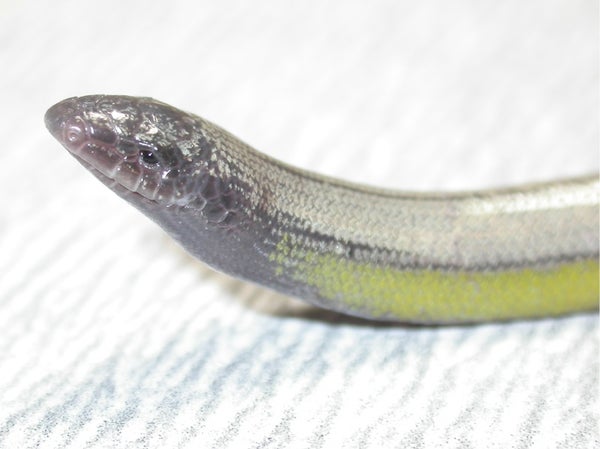
When a pair of herpetologists in California set out recently to collect samples of legless Anniella pulchra lizards, they were sure they’d find a new species. Instead, they found four.
Most researchers already agreed that A. pulchra was mistakenly being used to describe two separate species found throughout the Golden State. It was just about impossible that the tiny, subterranean creatures had moved across the mountain ranges dividing the northern and southern halves of California and yet avoided speciation.
The most surprising find of the four species, differentiated later by differences in their DNA, was A. grinnelli, which sports a purple belly. Yellow bellies are typical for the state’s lizards, says California State University, Fullerton, researcher James Parham. Along with Theodore Papenfuss of the University of California, Berkeley, Parham published findings on the new species in Breviora, a publication of the Museum of Comparative Zoology. To find the reclusive lizards Parham placed pieces of cardboard all over the state, then returned year after year to see if the dark, moist microhabitats had attracted any Anniella.
On supporting science journalism
If you're enjoying this article, consider supporting our award-winning journalism by subscribing. By purchasing a subscription you are helping to ensure the future of impactful stories about the discoveries and ideas shaping our world today.
Two of the species were found to live in the San Joaquin Valley, once home to the second-largest freshwater lake in the U.S., but now a highly developed agricultural and industrial center in central California. “The neatest thing,” Parham says, “is that even in the San Joaquin Valley, which isn’t exactly a tourist destination—in fact, it’s the punch line of many jokes, because of how much it’s been developed—there are still discoveries to be made.”
—Rachel Feltman