
Humans were long thought to have a monopoly on metacognition, which is the ability to contemplate one's own mental states. Captive apes have recently shown this skill by demonstrating that they are aware of the extent of their knowledge—they know when they are missing crucial information to solve puzzles or find food. Now a study in semiwild rhesus monkeys provides important evidence that metacognition is not the province of humans, apes or trained animals alone.
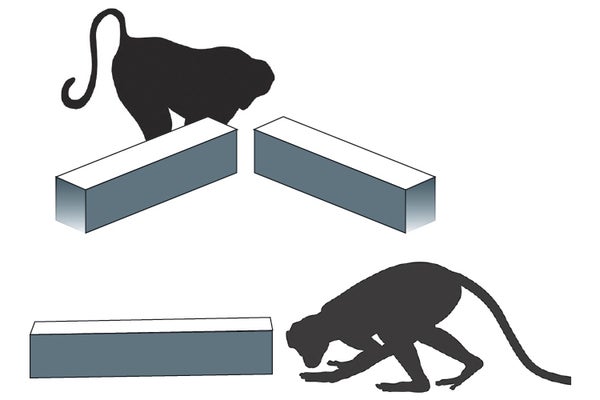
Alexandra Rosati of Harvard University and Laurie Santos of Yale University observed 120 rhesus monkeys searching for food the researchers had planted, either in one end of a single tube or in one of two tubes arranged in a V [see illustration above]. In both cases, half the monkeys could watch as the food was planted—so they knew where it was—while the other half had their view blocked by a screen. Each monkey took part just once.
The main question is what monkeys do in the screened, two-tube case. The most efficient strategy is to peer inside the gap in the crook of the V, which allows them to check both tubes for the food at once, but reliably choosing that approach requires metacognition. In particular, a monkey needs to recognize that it does not know where the food is hidden, then contemplate its options and choose a course of action.
On supporting science journalism
If you're enjoying this article, consider supporting our award-winning journalism by subscribing. By purchasing a subscription you are helping to ensure the future of impactful stories about the discoveries and ideas shaping our world today.
In this key condition, 27 of 30 monkeys began searching by peering inside the gap as compared with 13 in the unscreened, two-tube case—who already knew where the food was. The researchers ruled out the possibility that they were simply approaching the middle of the setup—fewer than a third in the one-tube cases approached the center. What is more, monkeys in the hidden, two-tube case took a few seconds longer to begin searching, suggesting they had reflected on what to do before acting.
“They could be randomly checking each location, but they're not,” which suggests that metacognition was at work, Rosati says.
Michael Beran of Georgia State University, who studies metacognition in apes, hails the study as important new evidence: “In demonstrating that this was true in a semiwild group of monkeys, we can have greater confidence that some animals engage in metacognitive processes.”