
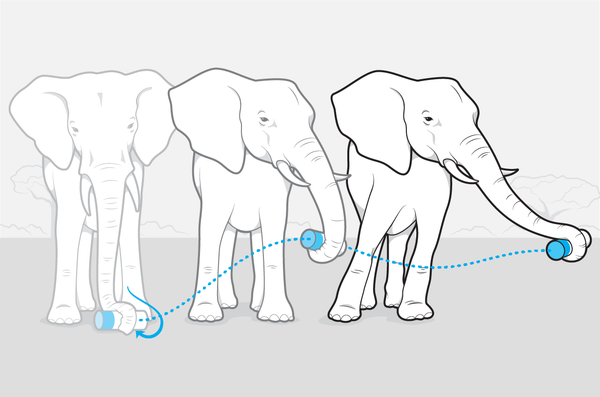
Elephants move their powerful trunks with precision and complexity, delicately picking up a single leaf as easily as they heft a log. But researchers have struggled to explain how, exactly, the trunks manage to do so. New research published in Current Biology reveals part of the answer, thanks to motion-capture technology typically used to make movies.
“Elephants have evolved these amazing organs with an infinite number of degrees of freedom,” says lead author and University of Geneva biologist Michel Milinkovitch. His team traveled to a South African elephant reserve to study how the animals specifically use that freedom. The researchers taped retroreflective markers to two bull elephants’ trunks and put various items in front of them. As the elephants moved the objects around, the researchers filmed them with a semicircle of infrared cameras, capturing how the markers moved in three-dimensional space—similar to the process used for mapping movie actors’ movements to computer-generated characters.

Credit: Brown Bird Design; Source: “Elephants Evolved Strategies Reducing the Biomechanical Complexity of Their Trunk,” by Paule Dagenais et al., in Current Biology, Vol. 31; November 8, 2021
On supporting science journalism
If you're enjoying this article, consider supporting our award-winning journalism by subscribing. By purchasing a subscription you are helping to ensure the future of impactful stories about the discoveries and ideas shaping our world today.
An elephant’s proboscis, like a human tongue, is a type of muscular hydrostat: it has no bones, so it can move in myriad ways. The new study shows that the bulls combine simple actions—such as curling, twisting and elongating parts of their trunks—to achieve complex movements. The animals also form pseudo-joints, or rigid sections of trunk, that they can shift from point to point.
“It’s the first time that we’ve gotten a hint of what these more simplified commands might be in elephants,” says William Kier, a biologist at the University of North Carolina at Chapel Hill, who studies trunk, tongue and tentacle movement and was not a part of the study. “I think it is a pretty important advance.”
This investigation into how an elephant’s 40,000 trunk muscles work together will be invaluable for developing new, versatile robots, says Cecilia Laschi, a roboticist at the National University of Singapore, who was not involved in the new study: “For roboticists, this is sort of a dream.” A team of engineers in Pisa using the study data expects to have a trunklike robot prototype in 18 months.