
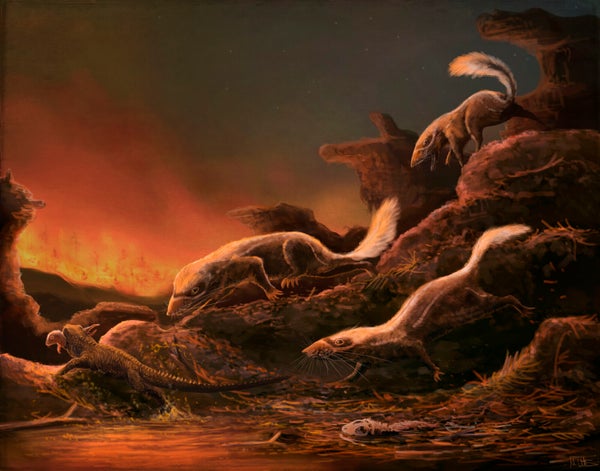
More than 220 million years ago, as early dinosaurs were just getting their legs under them, the first mammals evolved from a group of tiny, weasel-like reptiles called cynodonts. New research hints that mammals' huge success later on may be linked to a surprisingly small dietary choice: insects.
As cynodonts evolved into early mammals, they developed fewer teeth and skull bones. Paleontologists had long assumed these simplifications allowed for stronger skulls and multiple tooth types, letting mammals benefit from a greater variety of foods. Yet no one knew exactly what drove these changes, and now a study in Communications Biology has added a new facet to the story.
“The transition from cynodonts to mammals is a textbook example of repurposing existing skeletal elements,” says lead author Stephan Lautenschlager, a paleontologist at the University of Birmingham in England. In their study, Lautenschlager and his colleagues used digital models and biomechanical tests to investigate how the simpler early-mammal skulls held up to biting stresses. Rather than finding increased efficiency or stress resistance in general, they learned that the stress of simulated bites decreased across the top of the skull but increased along the cheek. The specific patterns, and the earliest mammals' relatively small size, are reminiscent of modern small insectivores—which use quick bites and a dental tool kit of puncturing and crushing teeth to bust through arthropod carapaces.
On supporting science journalism
If you're enjoying this article, consider supporting our award-winning journalism by subscribing. By purchasing a subscription you are helping to ensure the future of impactful stories about the discoveries and ideas shaping our world today.
“These findings suggest the patterns we see in the evolution of mammal skulls are more nuanced than we might have thought,” says Oxford University Museum of Natural History paleontologist Elsa Panciroli, who was not involved in the new research. “This study gives us fresh data to start getting closer to the answers.”
The insect-munching specialists' anatomical changes set the stage for mammal evolution through to today, the researchers say. The changes provided a foundation for later adaptations to feed on plants and larger animals; over time these pioneers became the Mesozoic equivalents of otters, raccoons, flying squirrels and aardvarks. “It's not about how hard you can bite,” Panciroli says, “but perhaps about the different ways in which you can bite and chew.”