
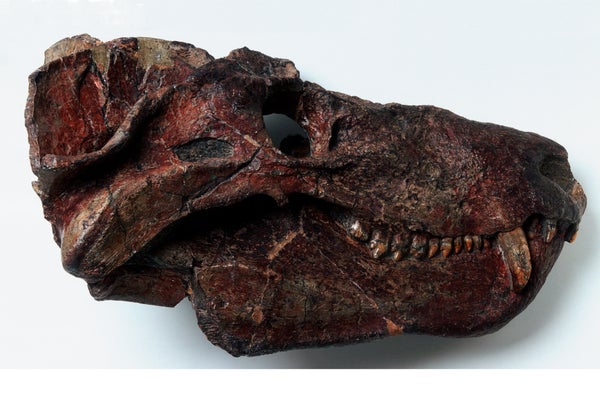
Two weird, mammal-like reptiles that sort of looked like scaly rats, each smaller than a loaf of bread, roamed ancient Brazil about 235 million years ago, likely dining on insects the predators snagged with their pointy teeth, a new study finds.
The analysis of two newfound species of cynodont, a group that gave rise to all living mammals, sheds light on how mammals developed from these late Triassic creatures, the researchers said.
"These new fossils help [us] understand in more detail the evolution of pre-mammalian forms that gave rise to the group of mammals, in which we humans (Homo sapiens) are included," the study's lead author, Agustín Martinelli, a paleontologist at the Federal University of Rio Grande do Sul in Brazil, told Live Science in an email. [In Photos: Mammals Through Time]
On supporting science journalism
If you're enjoying this article, consider supporting our award-winning journalism by subscribing. By purchasing a subscription you are helping to ensure the future of impactful stories about the discoveries and ideas shaping our world today.
Cynodonts predate dinosaurs, first appearing in the fossil record about 260 million years ago, during the Permian period. Their descendants include marsupial and placental mammals (the furry creatures usually thought of as mammals), as well as monotremes—mammals that lay eggs instead of giving birth to live young, such as the platypus and echidna, the researchers said.
However, the early cynodonts that lived during the late Permian and the early Triassic periods weren't mammals, but rather reptiles with mammal-like skulls and jaws, the researchers said.
The specimen of one of the newfound cynodont species has been resting in the collection department at the Museum of Earth Sciences in Rio de Janeiro, Brazil since 1946. That's when L.I. Price, a Brazilian paleontologist, found the two skulls and two jaws in rock dating to between 237 million and 235 million years ago in the Santa Cruz do Sul municipality of Brazil's southern state of Rio Grande do Sul.
Those specimens belong to a small animal of about 12 inches (30 centimeters) in length, with unusually large, protruding upper-canine teeth suggesting it ate insects. The creature's anatomy indicates that it is part of an extinct family of carnivorous cynodonts called Probainognathidae.
In fact, the newfound species is likely related to Probainognathus jenseni, a species discovered in Triassic-age rocks of the La Rioja province in western Argentina. But the researchers said the newly discovered creature is different enough to justify having its own genus and species:Bonacynodon schultzi. The name honors two eminent paleontologists, José Bonaparte from Argentina and Cesar Schultz from Brazil, both of whom spent their lives studying the Triassic fossils of South America.
The other newfound cynodont species, also discovered in the state of Rio Grande do Sul, was identified from fewer remains—just a jaw with teeth, the researchers said. The scientists dubbed it Santacruzgnathus abdalai,in honor of Fernando Abdala, an Argentinian paleontologist who studies South American and African cynodonts, the researchers said.
S. abdalai was about half the size of B. schultzi, measuring only 6 inches (15 cm) in length. The shape and dentition of S. abdalai's teeth are "reminiscent of those present in early mammals," Martinelli said.
However, both cynodonts lived millions of years before the appearance of the first known mammal: a shrew-like creature that lived about 160 million years ago in what is now China, experts told Live Science in 2011.
The new study was published online today (Oct. 5) in the journal PLOS ONE.
Copyright 2016 LiveScience, a Purch company. All rights reserved. This material may not be published, broadcast, rewritten or redistributed.