
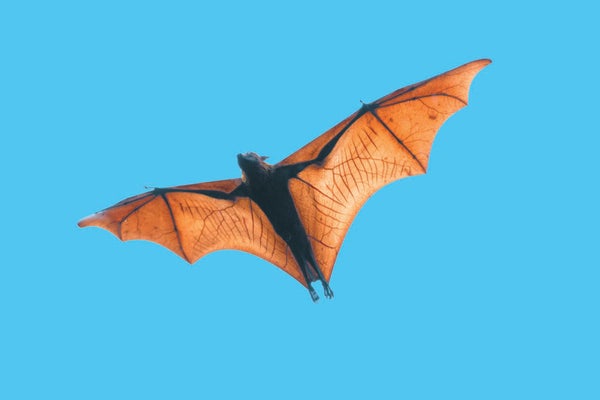
Bats have done something no other mammal ever has: the leathery-winged beasts evolved powered flight thanks to specialized membranes called patagia connecting their limbs and digits to the rest of their body. A new study of bat embryos in BMC Biology reveals a crucial step in how these once land-bound animals evolved to fly—and it may involve a gene known for detrimental mutations in humans.
Paleontologists have yet to discover fossils showing a transition to the earliest flying bats. But the embryonic development of today's living bats contains clues to these ancient changes.“The bat wing is a crazy amalgam of derived and novel anatomical elements,” says study author Karen Sears, a biologist at the University of California, Los Angeles. And the plagiopatagium, a specific patagium that connects the side of the body to the arms and legs, is among the most important. This tissue takes on a variety of shapes in different bat species, tending to be broader in fruit-eating species and narrower in ones that hunt flying insects. To detect whether these shapes came from an ancestral bat wing or evolved independently, Sears and her colleagues investigated the embryology of different bat species and the genes responsible for the tissue's development.
During development, the researchers found, the plagiopatagium grows from the side of the fetus's body and merges with its limbs. This pattern held across all the species studied, indicating an ancestral wing. A mutation in a particular gene called Ripk4 may have enabled the change.
On supporting science journalism
If you're enjoying this article, consider supporting our award-winning journalism by subscribing. By purchasing a subscription you are helping to ensure the future of impactful stories about the discoveries and ideas shaping our world today.
“Evolution is unpredictable, and development is often modified in ways that we cannot, or do not, anticipate,” Sears says. In humans and laboratory mice, mutations to Ripk4 can alter the skin to create patagiumlike structures and cleft lips, among other issues. About half of all living bat species have cleft palates—a feature that may be tied to bat echolocation.
The findings provide important evidence for how skin layers fuse together to form bats' essential flight membrane, says University of Melbourne biologist Charles Feigin, who was not involved in the new study. This fusion makes the wings resilient enough for powered flight, Feigin says; similar, weaker membranes in other airborne mammals limit them to gliding. A chance mutation might have been the key that opened the sky to bats.