
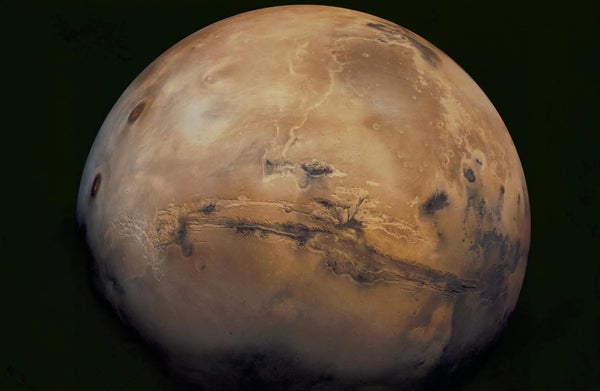
NASA has announced it will launch a nuclear-powered spacecraft to Mars before the end of 2028. The effort would mark a world first—no interplanetary spacecraft mission has ever been powered by nuclear propulsion before—and a massive boost for potential missions that would go farther out into space and travel faster than traditional liquid-fueled craft could manage.
The space agency plans to the launch the spacecraft, called Space Reactor-1 Freedom, to the Red Planet, where it will deploy several helicopters to explore the surface. The helicopters, NASA said in a statement, will be modeled on Ingenuity, which flew as part of the Perseverance Mars rover’s mission on the planet.
At a press conference on Tuesday, NASA’s Steve Sinacore said that it may be possible that the spacecraft will fly by Mars and continue onward. “We have not decided where the mission will end,” Sinacore said.
On supporting science journalism
If you're enjoying this article, consider supporting our award-winning journalism by subscribing. By purchasing a subscription you are helping to ensure the future of impactful stories about the discoveries and ideas shaping our world today.
According to NASA, the mission will prove nuclear propulsion can power spacecraft “and activate the industrial base for future fission power systems across propulsion, surface, and long-duration missions.” These could include missions to planets and other bodies in the outer solar system.
Currently, exploring these distant worlds in this way would be impossible with traditional craft, which would require massive amounts of liquid fuel to travel such distances. Only spacecraft that are small enough to be battery- or solar-powered, such as the Voyager and Juno missions, have reached these outer realms of our solar system.
Nuclear propulsion has long been touted as the solution to this problem, but it has never been proven to work in a mission. It is unclear what propulsion design NASA would use to test the system or if there will be any collaboration with industry. At the press conference on Tuesday, NASA officials did not offer additional details about what launch vehicle they might use for the mission other than saying that it would need to be approved by multiple regulatory agencies and have a track record of safe launches.
“NASA has been studying this for a very long time along with the Department of War,” Sinacore said, “and so technology is available.” Industry is also exploring these concepts, he added. "To me, it is a maturing of that technology that currently exists and then an integration into a vehicle,” Sinacore said.
Additional reporting by Dan Vergano.
Editor’s Note (3/24/26): This is a breaking news story and may be updated.