
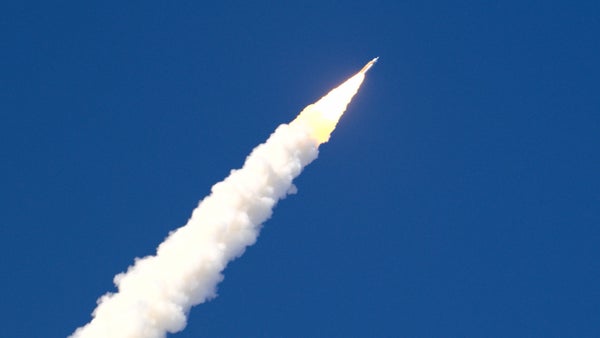
NASA officials on Wednesday hailed the successful launch of the Artemis II mission to the moon. The 10-day flight, which lifted off at 6:35 P.M. EDT from the Kennedy Space Center in Florida, will take four astronauts on a path around the far side of the moon and back that, if all goes as planned, will send them farther from Earth than any human has gone before.
The Artemis II crew is traveling onboard an Orion spacecraft and is made up of Reid Wiseman, Christina Koch, Jeremy Hansen and Victor Glover. At a press conference following the launch, NASA administrator Jared Isaacman praised the astronauts, adding that they had briefly lost communication with Earth-based control but that it had been reestablished.
“[They’re] safe, they’re secure, and they’re in great spirits,” Isaacman said. The four are the first astronauts to head toward the moon for more than 50 years.
On supporting science journalism
If you're enjoying this article, consider supporting our award-winning journalism by subscribing. By purchasing a subscription you are helping to ensure the future of impactful stories about the discoveries and ideas shaping our world today.
After about a day, the crew will leave Earth orbit on a path to the moon. The astronauts plan to conduct a lunar flyby on April 6, and after four days of travel, they are set to splash down on Earth on April 10. Along the way, the astronauts will test systems onboard the Orion spacecraft (including a cutting-edge space toilet), perform a series of test maneuvers of the Artemis II crew capsule, measure how their own bodies adapt to microgravity, and observe and image the moon in preparation for future lunar missions. They will likely see parts of the far side of the moon that no human has ever directly observed.
They will also get to experience an eclipse—when the moon will pass in front of the sun, leaving only the star’s corona visible—said Lori Glaze, acting associate administrator for NASA's Exploration Systems Development Mission Directorate, at the press event. “It’ll be pretty cool and unique opportunity,” she added.
For now, the crew is concentrating on making sure the Orion capsule, named Integrity, is on the correct trajectory to pull off a maneuver called a translunar injection burn, which will place them on the correct path toward the moon, on April 2. As of 9:14 P.M. EDT, the spacecraft was coasting after performing an apogee raise burn—a move that stabilized its orbital path around Earth.
Ahead of the launch, Isaacman called the mission the “opening act” for lunar exploration. Artemis II’s astronauts will not land on the moon. But Artemis IV, planned for 2028, does include a week on the lunar surface. Ultimately, NASA hopes to build a permanent base on the moon.
"After a brief, 54-year intermission, NASA is back in the business of sending astronauts to the moon," Isaacman said at the postlaunch press conference.
Editor’s Note (4/1/26): This is a breaking news story and may be updated.