
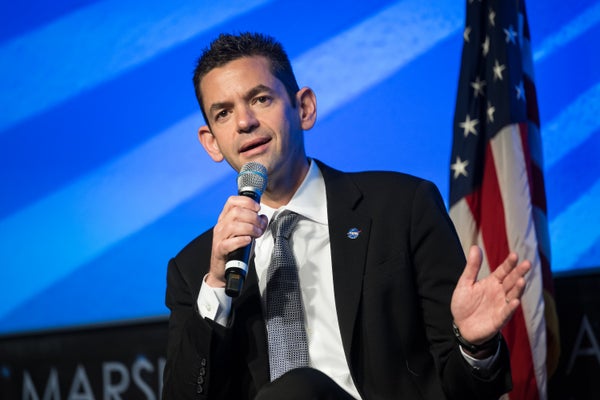
WASHINGTON, D.C.—NASA aims to establish a moon base within the next decade, space agency chief Jared Isaacman announced on Tuesday, unveiling a $30-billion plan to establish a permanent human presence on the lunar south pole by 2036. The announcement from NASA headquarters called for dozens of launches to the moon in the next decade and effectively canceled plans for a long-proposed orbiting lunar “Gateway” space station.
“This time the goal is not flags and footprints. This time the goal is to stay” on the moon, Isaacman said. The space agency will focus its human exploration efforts on developing the moon base, he said, and will follow the Apollo program’s pattern of flying full-fledged test missions before sending people. NASA will deprioritize the International Space Station and support the development of a separate commercial station that will be built by private companies at the orbiting lab and then detached.
The eventual goal will be to land human crews on the moon every six months to explore the lunar south pole, which is thought to harbor ice and other valuable materials in its shadowed craters. “America will never again give up the moon,” Isaacman said.
On supporting science journalism
If you're enjoying this article, consider supporting our award-winning journalism by subscribing. By purchasing a subscription you are helping to ensure the future of impactful stories about the discoveries and ideas shaping our world today.
NASA is currently targeting April 1 to launch its upcoming moon mission, Artemis II, which will send four astronauts on a journey around the moon in a test of the jumbo Space Launch System (SLS) rocket and the Orion space capsule. The space agency only recently announced a change of plans to its subsequent moon missions: in 2027 the Artemis III crewed flight will test how well Orion docks in orbit with two lunar landing vehicles that are being developed by SpaceX and Blue Origin. And then, in 2028, if all goes to plan, Artemis IV will land humans back on the moon for the first time in more than half a century.
The newly announced plans would accelerate and widen the Artemis program, requiring dozens of launches of rovers, drones, power, communications and habitat modules over three stages aimed at building a lunar outpost, said NASA Moon Base program official Carlos Garcia-Galan. The moon station will require radioactive isotope power sources, and eventually a nuclear reactor, to survive long periods of shadow on the lunar south pole. These periods sometimes last months and preclude solar power.
One of the most noteworthy parts of the space agency’s announcement may be NASA’s embrace of nuclear power, both for the moon base and a potential future Mars mission, says Casey Dreier of the Planetary Society. Nuclear electric propulsion would “open up huge opportunities for energy use in various science missions and, of course, crewed missions around the solar system,” he says.
The prime challenge of the “very ambitious plan” is “cadence: the numbers of lunar landings,” Garcia-Galan tells Scientific American. The first phase of the moon base program calls for two dozen launches to the moon, including the Artemis IV landing, by 2028. If those go smoothly, taxpayers will know the agency is meeting its goals, he says.
Rocket uncertainty could also present hurdles. The next four Artemis missions will rely on the space agency’s SLS rocket to deliver astronauts to the moon. After that, however, the vehicle for future launches is less certain, says NASA’s Lori Glaze, acting head of the agency’s human exploration directorate. A SpaceX Starship rocket is one option. A different version of Starship is also SpaceX’s contender as a lunar lander. The company is looking to lower the Starship lander’s number of needed on-orbit refueling missions, now estimated at around a dozen, in order to perform a test moon landing before it delivers any astronauts. “We made it quite clear we are going to land by 2028,” Glaze says.
China plans to land its own astronauts on the moon by 2030. In his announcement, Isaacman speculated that China may even beat its own deadline and that NASA may only get back to the moon first by a matter of “months, not years.”
Editor’s Note (3/24/26): This story is in development and may be updated.