
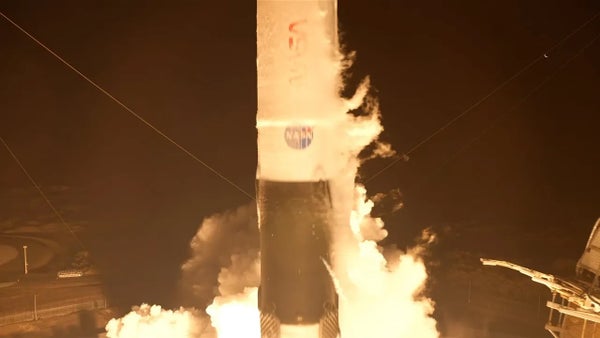
Four fresh astronauts are on their way to the International Space Station (ISS). On Friday at 5:15 A.M. EST, Crew-12 launched from Cape Canaveral, Fla., onboard a spacecraft on a SpaceX Falcon 9 rocket, kick-starting a day-long journey to orbit.
Crew-12 is composed of NASA astronauts Jessica Meir and Jack Hathaway, European Space Agency astronaut Sophie Adenot and Roscosmos cosmonaut Andrey Fedyaev. The quartet are set to dock at the station at approximately 3:15 P.M. EST on Saturday, February 14.
While in space, Crew-12 will perform a series of science experiments, including investigating how spaceflight and microgravity changes blood flow and whether vitamin B supplements can help help protect astronauts’ eyes from spaceflight-related changes. And they’ll perform some simulated moon landings. If all goes to plan, Crew-12 will also be part of a call with NASA’s Artemis II crew as those four astronauts wing their way around the moon, said Jared Isaacman, NASA’s administrator, at a press conference on Friday.
On supporting science journalism
If you're enjoying this article, consider supporting our award-winning journalism by subscribing. By purchasing a subscription you are helping to ensure the future of impactful stories about the discoveries and ideas shaping our world today.
Crew-12 replaces Crew-11—but unlike typical station handovers, the Crew-11 astronauts were evacuated from the ISS in January weeks ahead of their planned return. That decision came after one of the four members of that mission experienced an unknown medical issue—NASA has not revealed which astronaut encountered the problem.
Since Crew-11’s unprecedented early departure, the ISS has been staffed by just three people: one NASA astronaut, Chris Williams, and two cosmonauts, Sergey Kud-Sverchkov, the station commander, and Sergei Mikaev.
NASA has said no changes were made to Meir, Hathaway, Adenot and Fedyaev’s preparation or training as a result of what happened to Crew-11.