
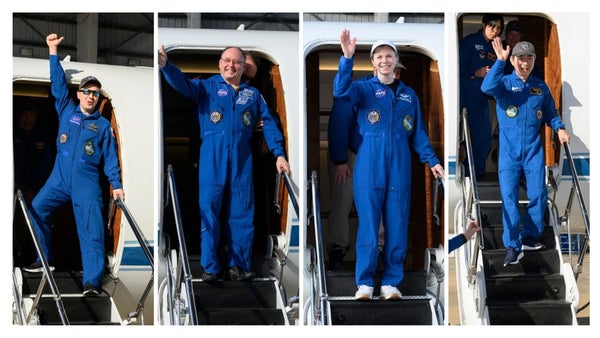
Just a week after their unprecedented return to Earth following a medical issue onboard the International Space Station, the four members of Crew-11 presented a united front, indicating that the future of human spaceflight was bright.
At a press conference on Wednesday, former ISS commander and NASA astronaut Mike Fincke said that the way the crew and ground teams came together to deliver the four astronauts safely back to Earth showed how well prepared humans are to continue to explore space.
“How we handled everything all the way through ... nominal operations to this unforeseen operation really bodes well for future exploration,” Fincke said. “So when we’re getting ready for Artemis, I am very optimistic.”
On supporting science journalism
If you're enjoying this article, consider supporting our award-winning journalism by subscribing. By purchasing a subscription you are helping to ensure the future of impactful stories about the discoveries and ideas shaping our world today.
Fincke is one of the four returned crew members—the others are NASA’s Zena Cardman, Japan Aerospace Exploration Agency (JAXA) astronaut Kimiya Yui and Russian cosmonaut Oleg Platonov—who were rushed back to Earth weeks ahead of schedule. On Wednesday, the four offered scant details of what exactly happened to trigger their early return to Earth—the first in the history of the ISS.
Fincke said the issue arose as he and Cardman were preparing to undertake a space walk—which would have been Cardman’s first—outside the ISS. Fincke also said that the ISS’s portable ultrasound machine was used to respond to the medical issue.
“So when we had this emergency, the ultrasound machine came in super handy,” Fincke said, adding the caveat that the ISS does not have the ability to house larger imagers, such as magnetic resonance imaging machines.
“We do try to make sure that everybody, before we fly, are really, really not prone to surprises. But sometimes things happen, and surprises happen,” Fincke said.
JAXA’s Yui praised his international colleagues for the response to the medical issue. “We can handle any kind of difficult situation,” he said. “This is actually very, very good experience for the future of human spaceflight.”
Looking beyond low-Earth orbit, Cardman said she did not think future crews on the ISS would necessarily need new or additional training in light of what happened to Crew-11. But, she said, missions beyond the ISS, to the moon or even further out in space, presented a different question. “I think the farther afield we go as we journey beyond low-Earth orbit, having tools on board to diagnose and treat a myriad of situations is going to be a really interesting problem to solve,” she said.
Cardman emphasized the ISS’s pioneering role in human spaceflight. Looking ahead to future space exploration and science expeditions, “we’re going to need astronauts to be the eyes and ears and lab notebook for the researchers on the ground,” she said.
“We’re not always going to be the scientific experts. In fact, we rarely will be,” Cardman said. “The ISS has been an excellent proving ground for how we get science done.”