
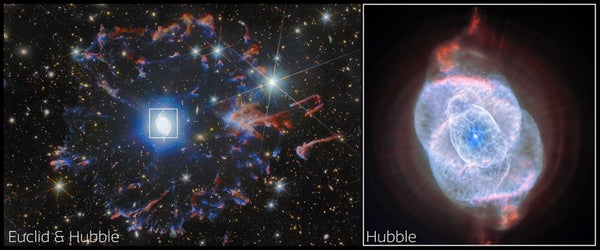
In 1995 NASA published images captured by the then nearly five-year-old Hubble Space Telescope of what the agency described as “one of the most complex planetary nebulae ever seen.” The photographs showed a dying star, or perhaps even stars, cocooned in striking red and green clouds of gas—the so-called Cat’s Eye Nebula. And now, more than 30 years later and alongside the space telescope Euclid, Hubble has trained its eye back on the nebula, revealing it in even more stunning detail.
The images capture a wider view of the nebula, highlighting a ring of material radiating from its center. Incredibly, this “halo” was expelled from the star system before the rest of the nebula formed.
The combined observations “reveal the remarkable complexity of stellar death in this object,” NASA said in a blog post.
On supporting science journalism
If you're enjoying this article, consider supporting our award-winning journalism by subscribing. By purchasing a subscription you are helping to ensure the future of impactful stories about the discoveries and ideas shaping our world today.
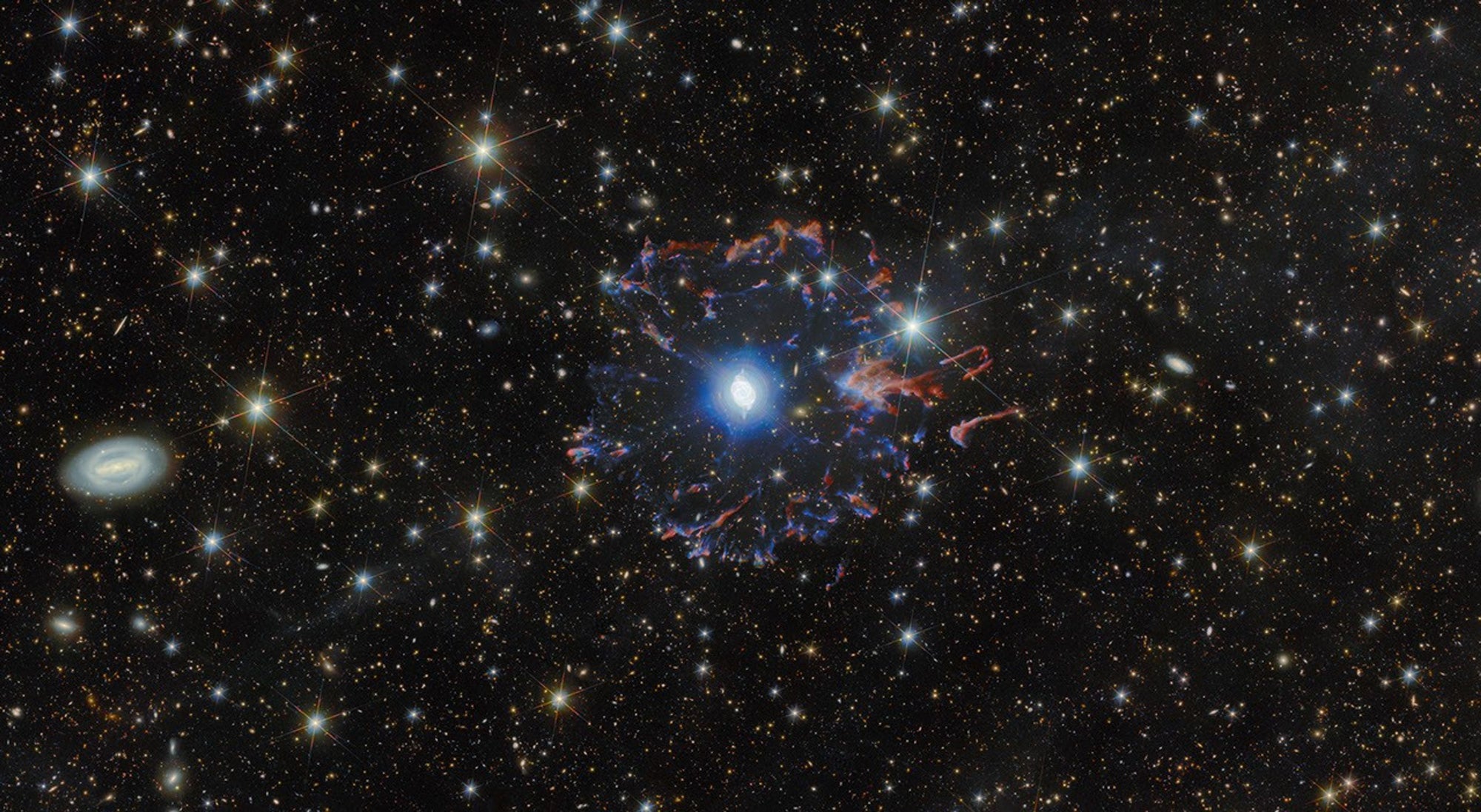
The Hubble Space Telescope and the Euclid space telescope joined forces to produce this image of the Cat’s Eye Nebula.
ESA/Hubble/NASA/ESA Euclid/Euclid Consortium/NASA/Q1-2025/J.-C. Cuillandre/E. Bertin/CEA Paris-Saclay/Z. Tsvetanov
Some of the new Hubble observations show the Cat’s Eye Nebula, also known as NGC 6543, in the finest detail ever seen. The nebula lies some 4,400 light-years away from Earth.
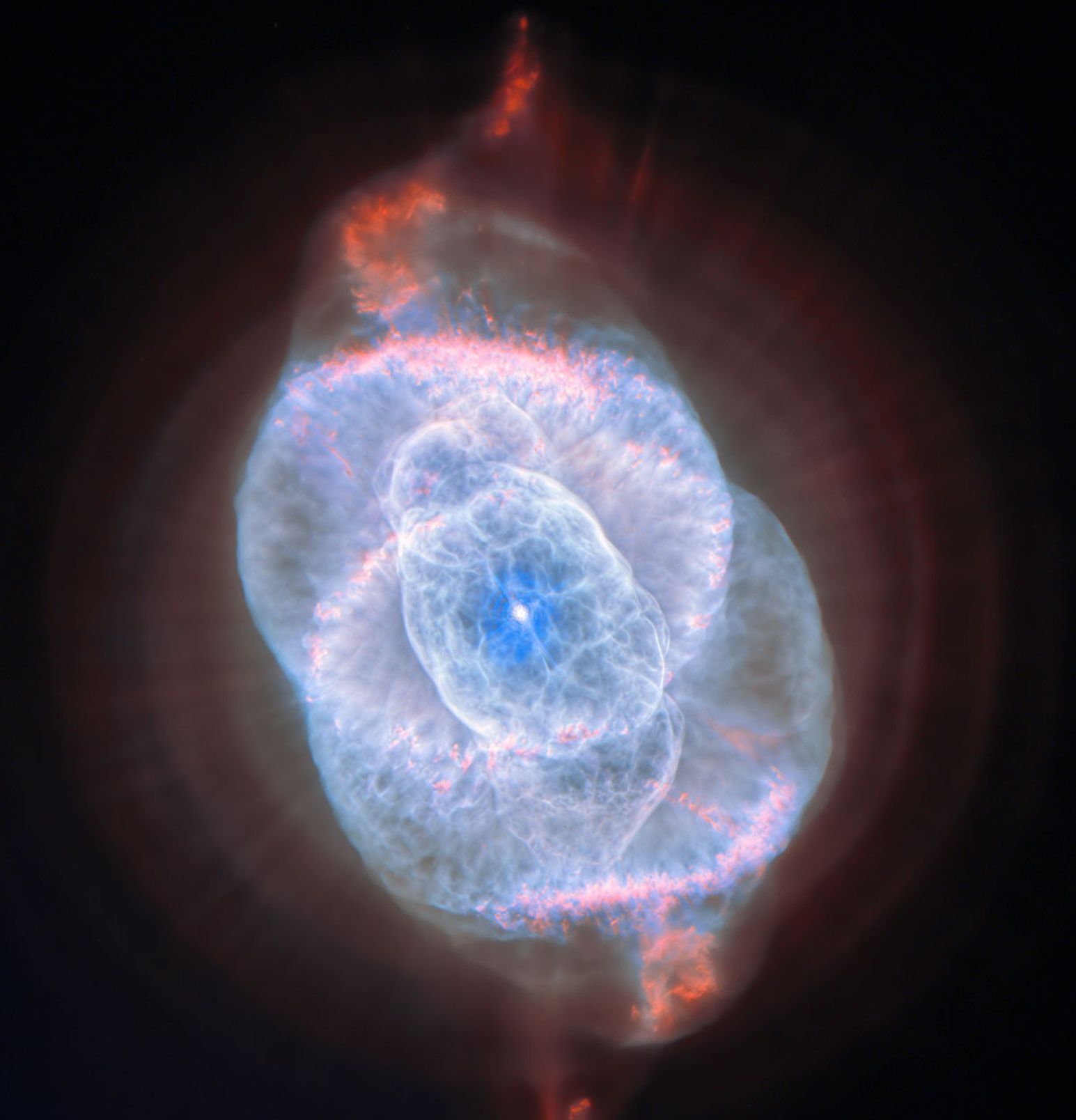
Hubble’s new image of the Cat’s Eye Nebula.
ESA/Hubble/NASA/Z. Tsvetanov
“The data reveal a tapestry of concentric shells, jets of high-speed gas and dense knots sculpted by shock interactions, features that appear almost surreal in their intricacy,” NASA wrote.
The observations could offer clues to how nebulas like this one form. By examining the structure of the Cat’s Eye Nebula in detail, astronomers can trace back the history of the dying star at its center—essentially enabling them to read a “cosmic ‘fossil record’ of [the star’s] final evolutionary stages,” NASA said.