New Issue: Orbital Catastrophe Ahead? Read Now

Dark Matter Telescope Captures a Sparkling Galaxy Merger

The Euclid Space Telescope is decking the halls with boughs of starlight

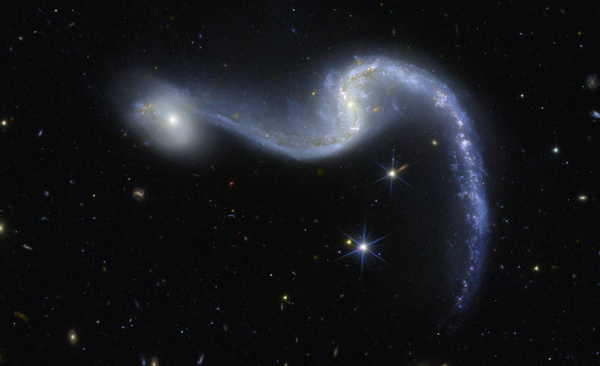
An image of space made by the Euclid telescope shows a bright barred spiral galaxy with two sweeping arms glowing in shades of blue and white against a deep black background dotted with stars. Its core is luminous. Its spiral arms curve gracefully outward to the left and down to the right, resembling a cosmic garland draped across the scene. A smaller, faint and round galaxy appears to the left of the barred spiral galaxy.

ESA/Euclid/Euclid Consortium/NASA, image processing: Euclid Science Ground Segment and M. Schirmer (MPIA) (CC BY-SA 3.0 IGO)

Join Our Community of Science Lovers!

A languid spiral galaxy appears draped against deep space in a stunning new image from the European Space Agency’s Euclid telescope.

Euclid launched in 2023 on a six-year mission to map the cosmos at scale, observing billions of galaxies stretching as far away as 10 billion light-years from Earth. The effort could reveal how galaxies form and evolve and how the universe has expanded over its 13.8-billion-or-so-year history.

In turn, astronomers hope Euclid will shed light on dark matter, which we know tugs at normal matter but is utterly invisible to us, and dark energy, the force that is responsible for accelerating the speed at which the universe expands.


On supporting science journalism

If you're enjoying this article, consider supporting our award-winning journalism by subscribing. By purchasing a subscription you are helping to ensure the future of impactful stories about the discoveries and ideas shaping our world today.


That effort will begin in earnest next year, when Euclid releases its first formal batch of data, which will account for about 14 percent of its final survey area.

Until then, the Euclid team has offered the occasional teaser for the telescope’s power, including a festive new image of the galaxy NGC 646. This elegant spiral galaxy, filled with stars, is about 392 million light-years away from Earth—some 4 percent of the distance of Euclid’s farthest targets—and is retreating at more than 5,000 miles per second.

Appearing at the left tip of NGC 646 is a second galaxy, known as PGC 6014—but their apparent closeness is merely an optical illusion; in truth, PGC 6014 is nearly 45 million light-years closer to Earth.

Meghan Bartels is a science journalist based in New York City. She was previously a senior reporter at Scientific American. Before that she spent more than four years as a writer and editor at Space.com, as well as nearly a year as a science reporter at Newsweek, where she focused on space and Earth science. Her writing has also appeared in Audubon, Nautilus, Astronomy and Smithsonian, among other publications. She attended Georgetown University and earned a master’s degree in journalism at New York University’s Science, Health and Environmental Reporting Program.

More by Meghan Bartels

Subscribe to Support Independent Journalism

Great science journalism requires human expertise, time, effort and creativity. And it costs money. That’s why I and the journalists here at Scientific American hope you’ll join our community.

When you subscribe, you are supporting staff and freelance journalists who are passionate about telling science stories that are true, important and compelling. Our editors and reporters are often experts in their fields, which means they understand the nuances of big discoveries and can untangle the breakthroughs from the hype. With a subscription, you are also supporting rigorous fact-checking to ensure the words we publish are precise and accurate. And you’re supporting original illustrations, graphics and photos that bring you closer to an advanced laboratory, an ice sheet in Antarctica or a space mission in orbit. You’re helping us craft other types of high-quality journalism as well: Our newsletters are carefully written, edited and curated by staffers you have or will come to know and love. Our Science Quickly podcast is based on original reporting, collaboration with editors and scientists and exacting production.

Subscriptions keep this engine running so we can continue to deliver thoughtful, rigorous and independent science journalism to you. In an era of viral misinformation, this work is crucial. If you value what we do, I hope you’ll consider joining us as a subscriber

Thank you,

Jeanna Bryner, Editor in Chief, Scientific American

Subscribe