New Issue: Orbital Catastrophe Ahead? Read Now

NASA’s Artemis II launch rehearsal hits a snag

NASA engineers temporarily stopped pumping liquid hydrogen fuel into the Artemis II rocket because of an apparent leak

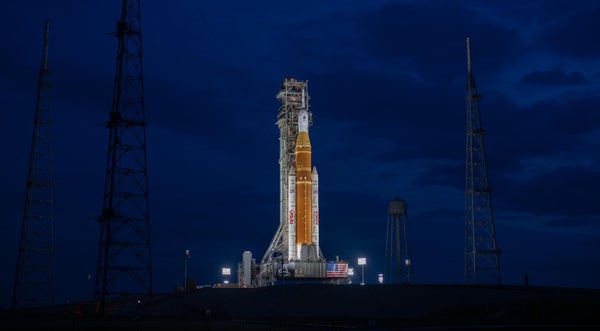
Lights illuminate NASA’s Artemis II SLS (Space Launch System) rocket and Orion spacecraft at Launch Complex 39B at NASA’s Kennedy Space Center in Florida on January 18, 2026.

NASA/Brandon Hancock

Join Our Community of Science Lovers!

NASA’s wet dress rehearsal—a crucial test of the agency’s Artemis II mission to the moon—hit a snag on Monday.

Engineers had been fueling the mission’s Space Launch System (SLS) rocket up with liquid hydrogen and liquid oxygen propellant and planned to initiate a countdown sequence to simulate the launch. But hours into the process, NASA engineers had to temporarily stop the flow of liquid hydrogen into the core stage of the SLS, which houses the rocket’s main engines, to investigate and troubleshoot several potential leaks.

NASA said it had resumed fueling a short time later. “Engineers will attempt to complete filling and then begin topping off the tank. Should that be successful, they will attempt to manage the hydrogen concentration, keeping it within acceptable limits during core stage hydrogen loading,” the agency said in a statement.


On supporting science journalism

If you're enjoying this article, consider supporting our award-winning journalism by subscribing. By purchasing a subscription you are helping to ensure the future of impactful stories about the discoveries and ideas shaping our world today.


Liquid oxygen (the other main component of the rocket’s fuel) was still flowing into the core stage throughout the issue. As part of the troubleshooting effort, NASA also temporarily paused liquid hydrogen loading into the upper stage, which was designed to loft the Orion crew capsule toward its orbital journey around the moon.

Fuel leaks also plagued the predecessor to Artemis II in testing and held up the launch of that mission, Artemis I, for weeks.

Artemis II will see four astronauts fly a 10-day loop around the moon and back to Earth, a journey that will take them farther into space than any human has gone before. If the wet dress rehearsal is a success, then the mission will launch no earlier than February 8.

Editor’s Note (2/2/26): This is a developing story and will be updated.

Subscribe to Support Independent Journalism

Great science journalism requires human expertise, time, effort and creativity. And it costs money. That’s why I and the journalists here at Scientific American hope you’ll join our community.

When you subscribe, you are supporting staff and freelance journalists who are passionate about telling science stories that are true, important and compelling. Our editors and reporters are often experts in their fields, which means they understand the nuances of big discoveries and can untangle the breakthroughs from the hype. With a subscription, you are also supporting rigorous fact-checking to ensure the words we publish are precise and accurate. And you’re supporting original illustrations, graphics and photos that bring you closer to an advanced laboratory, an ice sheet in Antarctica or a space mission in orbit. You’re helping us craft other types of high-quality journalism as well: Our newsletters are carefully written, edited and curated by staffers you have or will come to know and love. Our Science Quickly podcast is based on original reporting, collaboration with editors and scientists and exacting production.

Subscriptions keep this engine running so we can continue to deliver thoughtful, rigorous and independent science journalism to you. In an era of viral misinformation, this work is crucial. If you value what we do, I hope you’ll consider joining us as a subscriber

Thank you,

Jeanna Bryner, Editor in Chief, Scientific American

Subscribe