
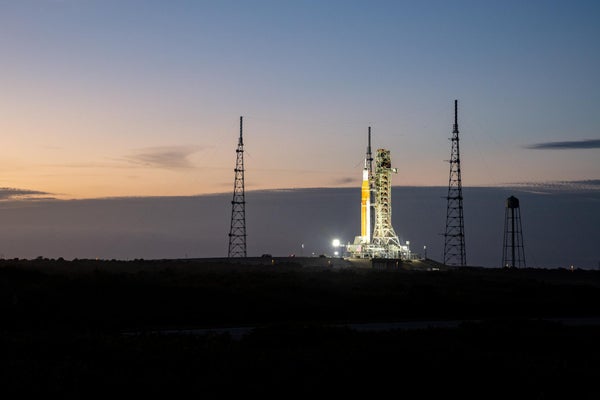
NASA is gearing up to launch Artemis II, the agency’s highly anticipated first crewed mission to moon in more than half a century. A crucial step is Artemis II’s “wet” dress rehearsal—a major test of the Space Launch System (SLS) rocket and the Orion capsule that will house the mission’s four astronauts. At Florida’s Kennedy Space Center, engineers will attempt to fuel the rocket and simulate a countdown to launch as soon as January 31, the agency said in an update on Monday.
If it all goes smoothly, the agency’s plan to slingshot four astronauts around the moon and back to Earth will go ahead, with a launch date coming as early as the first week of February.
The wet dress rehearsal will see NASA technicians load up the uncrewed spacecraft’s rocket with more than 700,000 gallons of cryogenic fuel—specifically, liquid oxygen and liquid hydrogen—before running through a countdown to launch.
On supporting science journalism
If you're enjoying this article, consider supporting our award-winning journalism by subscribing. By purchasing a subscription you are helping to ensure the future of impactful stories about the discoveries and ideas shaping our world today.
The test could result in the SLS and Orion being wheeled back from the launchpad for further tinkering, however. That’s what happened in 2022, when the uncrewed Artemis I mission sprung multiple liquid hydrogen fuel leaks on the launchpad and during testing—a recurring problem that delayed its launch significantly.
Aside from Artemis II’s coming wet dress rehearsal, NASA is also testing the water systems onboard Orion to make sure its water is fit to drink. “Initial samples showed higher levels of total organic carbon than expected,” the agency said in the same update on Monday. Officials have also made adjustments to the emergency exit system at the pad. The system is made up of a series of gondolalike baskets that are meant to carry the crew and launchpad staff to safety, should something go wrong.
Weather conditions could also affect the timing of Artemis II’s launch. Temperatures at the Space Center hit the low 40s Fahrenheit on Tuesday but are expected to rise going into the weekend. The agency is taking steps to prepare for the colder than usual temperatures, NASA said in the same statement.