New Issue: Science’s Impossible Questions. Read Now

NASA’s Artemis II moon mission reaches greatest distance from Earth

The space exploration milestone came during a 40-minute period during which the Artemis II astronauts were unable to communicate with Earth

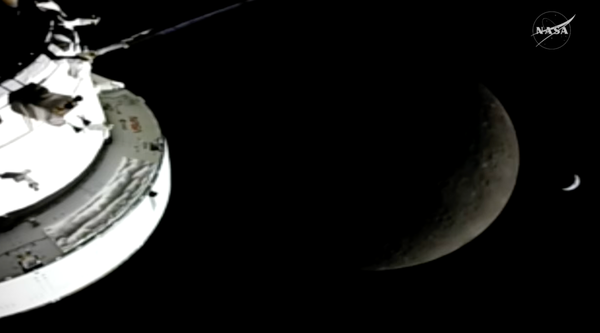
A grainy view of a spacecraft, the crescent moon and the crescent Earth.

The Artemis II Orion capsule, the moon and the Earth all seen from a camera at the tip of one of Orion’s solar arrays.

NASA TV

NASA has launched four astronauts on a pioneering journey around the moon—the Artemis II mission. Follow our coverage here.

Join Our Community of Science Lovers!

For NASA’s Artemis II mission, there’s nowhere to go now but home.

At 7:02 P.M. EDT on Monday, April 6, NASA astronauts Reid Wiseman, Victor Glover and Christina Koch and Canadian Space Agency astronaut Jeremy Hansen reached their greatest distance from Earth—around 252,756 miles (406,771 kilometers). The crew also reached their closest approach to the moon—4,067 miles above the lunar surface—at 7 P.M., according to NASA.

The four astronauts experienced the milestone alone. It came during a quiet 40 minutes, when all radio signals from Earth were blocked by the moon’s mass, meaning the crew could not communicate with ground control.


On supporting science journalism

If you're enjoying this article, consider supporting our award-winning journalism by subscribing. By purchasing a subscription you are helping to ensure the future of impactful stories about the discoveries and ideas shaping our world today.


“From all of us, it’s a privilege to witness you carrying the fire past our farthest reach,” Jenni Gibbons, a Canadian astronaut serving as capsule communicator, said from mission control to the astronauts before that period began.

“Thank you to all of you for allowing us the immense privilege to be on this journey together; it’s quite amazing,” Glover replied.

“As we continue to unlock the mysteries of the cosmos,” he said, “I would like to remind you of one of the most important mysteries there on Earth, and that’s love.... As we prepare to go out of radio communication, we’ll still feel your love from Earth. And to all of you down there on Earth, and around Earth, we love you from the moon.”

Reaching the farthest distance from Earth marks the second superlative of the mission during that “loss of signal” period—as noted, just minutes prior, the crew made their closest approach to the moon, flying about 4,067 miles (6,545 kilometers) above its surface. At this distance, the moon appeared about the same size as a basketball held at arm’s length.

Graphic shows the flight path of the Artemis II mission.

Amanda Montañez; Source: NASA (reference)

The Orion capsule reenters communication range with Earth at around 7:25 P.M. EDT. The crew will focus on observing the moon for at least two more hours, gathering as much data—and soaking up as much of the experience—as possible.

Hours ago the Artemis II crew broke the record for how far humans have traveled from Earth. The previous record was set by the crew of Apollo 13 in 1970 during their emergency loop around the moon after an oxygen tank exploded on the third day of that mission. The Artemis II crew has surpassed that record by about 4,101 miles (6,600 kilometers).

All told, the 10-day Artemis II journey will encompass nearly 700,000 miles (about 1.1 million kilometers)—the equivalent of circling Earth’s equator about 27 times.

Meghan Bartels is a science journalist based in New York City. She was previously a senior reporter at Scientific American. Before that she spent more than four years as a writer and editor at Space.com, as well as nearly a year as a science reporter at Newsweek, where she focused on space and Earth science. Her writing has also appeared in Audubon, Nautilus, Astronomy and Smithsonian, among other publications. She attended Georgetown University and earned a master’s degree in journalism at New York University’s Science, Health and Environmental Reporting Program.

More by Meghan Bartels

Subscribe to Support Independent Journalism

Great science journalism requires human expertise, time, effort and creativity. And it costs money. That’s why I and the journalists here at Scientific American hope you’ll join our community.

When you subscribe, you are supporting staff and freelance journalists who are passionate about telling science stories that are true, important and compelling. Our editors and reporters are often experts in their fields, which means they understand the nuances of big discoveries and can untangle the breakthroughs from the hype. With a subscription, you are also supporting rigorous fact-checking to ensure the words we publish are precise and accurate. And you’re supporting original illustrations, graphics and photos that bring you closer to an advanced laboratory, an ice sheet in Antarctica or a space mission in orbit. You’re helping us craft other types of high-quality journalism as well: Our newsletters are carefully written, edited and curated by staffers you have or will come to know and love. Our Science Quickly podcast is based on original reporting, collaboration with editors and scientists and exacting production.

Subscriptions keep this engine running so we can continue to deliver thoughtful, rigorous and independent science journalism to you. In an era of viral misinformation, this work is crucial. If you value what we do, I hope you’ll consider joining us as a subscriber

Thank you,

Jeanna Bryner, Editor in Chief, Scientific American

Subscribe