
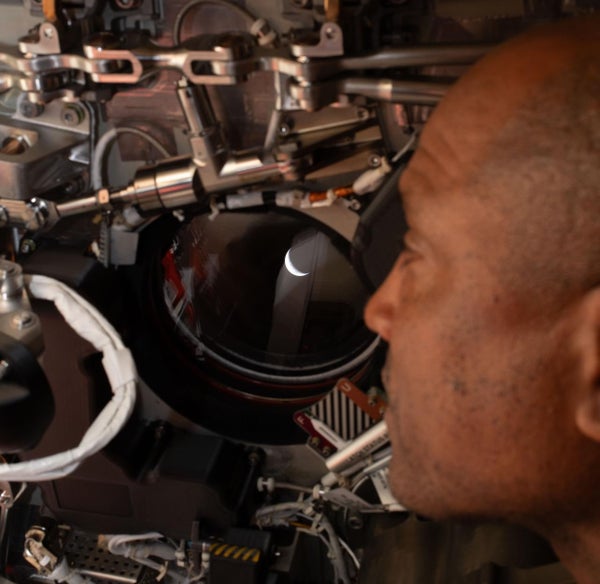
The four astronauts onboard NASA’s Artemis II mission to the moon have officially traveled farther from our home planet than any other human.
At 1:57 P.M. EDT on Monday, NASA astronauts Reid Wiseman, Victor Glover, and Christina Koch and Canadian Space Agency astronaut Jeremy Hansen exceeded the distance of 248,655 miles (400,171 kilometers) from Earth, the previous record set in 1970 by Apollo 13 astronauts James Lovell, John Swigert and Fred Haise.
“Today, for all humanity, you’re pushing that frontier,” Jenni Gibbons, a Canadian astronaut serving as capsule communicator, said from Mission Control to the astronauts.
On supporting science journalism
If you're enjoying this article, consider supporting our award-winning journalism by subscribing. By purchasing a subscription you are helping to ensure the future of impactful stories about the discoveries and ideas shaping our world today.
“As we surpass the furthest distance humans have ever traveled from Planet Earth, we do so in honoring the extraordinary efforts and feats of our predecessors in human space exploration,” Hansen said in response. “We will continue our journey even further into space before Mother Earth succeeds in pulling us back to everything that we hold dear, but we most importantly choose this moment, to challenge this generation, and in the next to make sure this record is not long lived.”
The Apollo 13 mission set the record only out of necessity. On the third day of the mission, when the astronauts were some 205,000 miles (330,000 kilometers) away from Earth, an explosion took out one of the oxygen tanks in their service module. NASA had to scramble to bring the crew home safely, quickly determining that their capsule could essentially slingshot around the moon, using its gravity to boost the astronauts’ return to Earth as soon as possible.
That decision—in addition to saving the crew’s lives—happened to bag them the record for the farthest distance humans had ever traveled from Earth (although apparently no one realized until decades later).

Amanda Montañez; Source: NASA (reference)
Two factors determine the overall distance that a mission looping around the moon will travel. The first is where the moon happens to be in its orbit around Earth: during its monthly circuit around our planet, the moon’s distance ranges from 363,300 kilometers (about 226,000 miles) at its closest to 405,500 kilometers (about 251,000 miles) at its farthest.
The second factor is how close to the moon’s surface the mission actually gets. The Artemis II crew members are expected to zip within just more than 4,000 miles (about 6,500 kilometers) above the lunar surface. At their Orion capsule’s closest approach, the moon is expected to look like it is approximately the size of a basketball held at arm’s length.
The Artemis II mission trajectory will carry the crew to their most distant point—252,757 miles (406,773 kilometers) away from Earth—later today.
Editor's note (4/6/26): This is a developing news story and will be updated.