
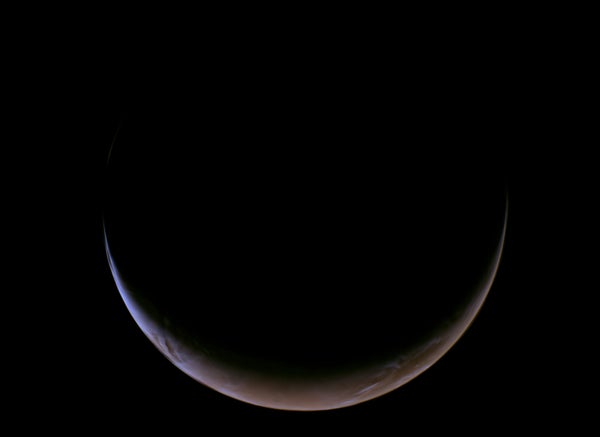
NASA’s Psyche mission to study an asteroid of the same name beyond Mars played tourist last week, with the spacecraft flying by the Red Planet and snapping photographs as it went. Coming within 2,864 miles of the planet’s surface at its closest approach, Psyche used the planet’s gravity to boost its speed and adjust its course toward its ultimate destination: a metal-rich asteroid called 16 Psyche, which lies between Mars and Jupiter.
Among the new photographs are a high-resolution snap of Mars’s south pole, which is home to a 430-mile-wide ice cap.

NASA/JPL-Caltech/ASU
On supporting science journalism
If you're enjoying this article, consider supporting our award-winning journalism by subscribing. By purchasing a subscription you are helping to ensure the future of impactful stories about the discoveries and ideas shaping our world today.
The Psyche mission began its six-year-long, 2.2-billion-mile trek into the solar system on October 13, 2023. After the probe reaches the asteroid by August 2029, the spacecraft will begin orbiting its namesake while snapping photographs and mapping the surface. It will also use its onboard science instruments—a magnetometer, a gamma-ray and neutron spectrometer and a multispectral imager—to try to determine 16 Psyche’s chemical composition.
The Mars flyby allowed the Psyche team not only to test out the spacecraft’s cameras but also to see how it and NASA’s Deep Space Network (DSN) communicate. The DSN measures Doppler shifts, or changes in radio wave frequencies caused by relative motion, to track spacecraft in deep space. NASA has a digital reconstruction of the flyby that can be viewed here.

This view of the Martian surface shows streaks that have formed because of wind blowing over impact craters in the Syrtis Major region.
NASA/JPL-Caltech/ASU
“We’ve confirmed that Mars gave the spacecraft a 1,000 mile‑per‑hour boost and shifted its orbital plane by about 1 degree relative to the Sun,” said Psyche navigation lead Don Han in a statement. “We are now on course for arrival at the asteroid Psyche in summer 2029.”
The asteroid 16 Psyche is large, measuring around 173 miles across at its widest point. Some scientists theorize that the rock is actually made of metals from the core of a planetesimal—a large, solid space object that acts as a building block of planets. And because it is currently impossible to bore a hole into Earth’s core to better understand how our planet first formed, studying objects like 16 Psyche could be the next best thing.