
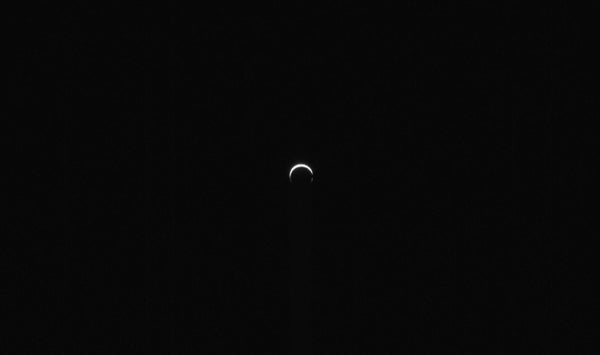
For NASA’s Psyche mission, the path to the metallic asteroid of the same name lies on the other side of Mars.
The mission launched in 2023 and has spent the intervening years looping through the inner solar system as part of a 2.2-billion-mile journey that will see it arrive at the asteroid Psyche in August 2029. The trek requires conducting what NASA operators call a gravity assist flyby of Mars—a maneuver that will give the spacecraft a little extra speed and align it with Psyche’s slightly tilted orbit around the sun. But mission personnel are making the most of the maneuver, using it not only to adjust the spacecraft’s trajectory but also to field-test its instruments and gather some unique science data.
“It’s just a really beautiful moment for all the instruments to practice,” says Lindy Elkins-Tanton, a planetary scientist at the University of California, Berkeley, and principal investigator of the Psyche mission. “The instrument teams wanted to do so much practice that the spacecraft team had to say, ‘We can’t quite let you all practice as much as you want because we actually have to do the Mars gravity assist.’”
On supporting science journalism
If you're enjoying this article, consider supporting our award-winning journalism by subscribing. By purchasing a subscription you are helping to ensure the future of impactful stories about the discoveries and ideas shaping our world today.
NASA/JPL-Caltech/ASU
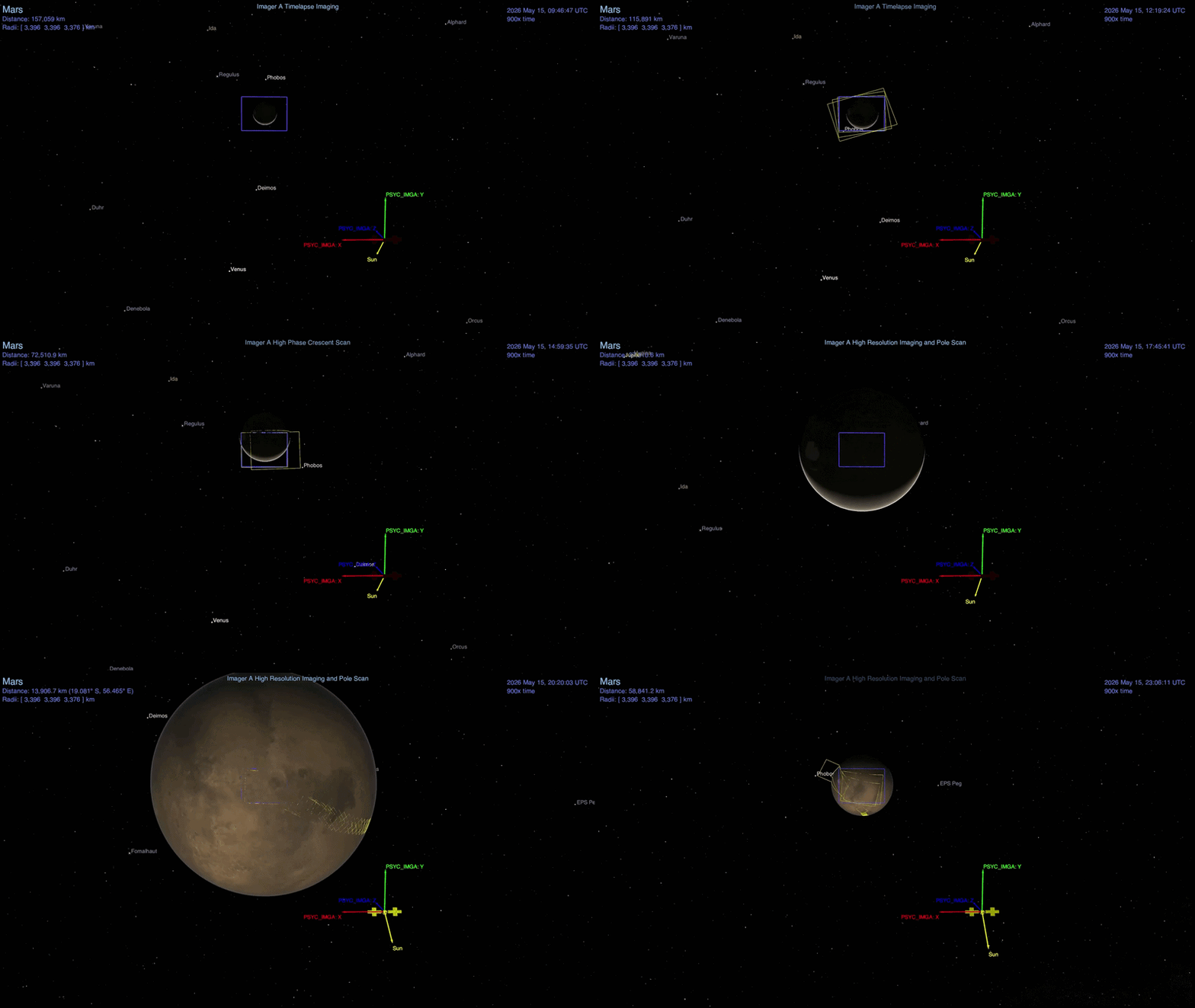
The Psyche spacecraft will make its closest approach to Mars on Friday at 3:28 P.M. EDT, when it will pass approximately 2,800 miles above the planet’s surface. (For comparison, the Artemis II crew came within about 4,000 miles of the moon’s surface during their mission last month.)
Mars has been in Psyche’s sights since early May, with the planet appearing as a steadily growing and surprisingly bright crescent in the approaching spacecraft’s view. Caused by sunlight-scattering dust in the Martian atmosphere, that unexpected brilliance seems to be planet-wide—save for a region near the world’s north pole. There, scientists guess that lower temperatures are causing carbon dioxide to freeze out of the atmosphere, with the CO2 falling as dry-ice snow and pulling dust down with it.
Psyche’s scientists have particularly enjoyed seeing Mars in the crescent phase because it’s a perspective that is rarely afforded by typical interplanetary voyages. “Most of the missions that go from Earth to Mars are flying outbound to Mars, and Mars is lit up by the sun fully, so you see the ‘full disk’ view,” says David Williams, a planetary scientist at Arizona State University and the mission’s deputy imager lead. That isn’t the case for Psyche: its journey has already taken the spacecraft swooping through the asteroid belt that lies between Mars and Jupiter, allowing it to approach a crescent Mars before using the planet to slingshot itself back into the asteroid belt.
All of Psyche’s instruments will be operating during the flyby, but the most intriguing observations will come from the imager that Williams works with. The instrument includes twin cameras that capture both visible and near-infrared light.
At the asteroid Psyche, those cameras will let scientists map the dark surface and study its composition. But first, the imager will scout the asteroid’s immediate neighborhood to check for any moonlets that could pose hazards to the spacecraft or offer clues to the space rock’s murky past. Any natural satellites of Psyche could’ve been ejected from the body by ancient impacts—or might’ve even been captured from deep space by chance encounters as the asteroid drifted through the solar system. During the Mars flyby, scientists will perform similar observations as practice, although no one expects to discover any previously hidden Martian moons.
As part of its dry run at Mars, the spacecraft will also practice hunting for faint circumplanetary rings of dust that might originate from the planet’s small moons and be backlit by the sun into clearer visibility. “Wouldn’t it be amazing if there was dust being shed off one of the Martian moons creating a dust ring around the planet, and you wouldn’t be able to see that unless you looked from the backside?” Elkins-Tanton says. That would be amazing, yes, but the mission team isn’t betting on it. “I will be surprised if we do see a dust ring at Mars,” Williams says.
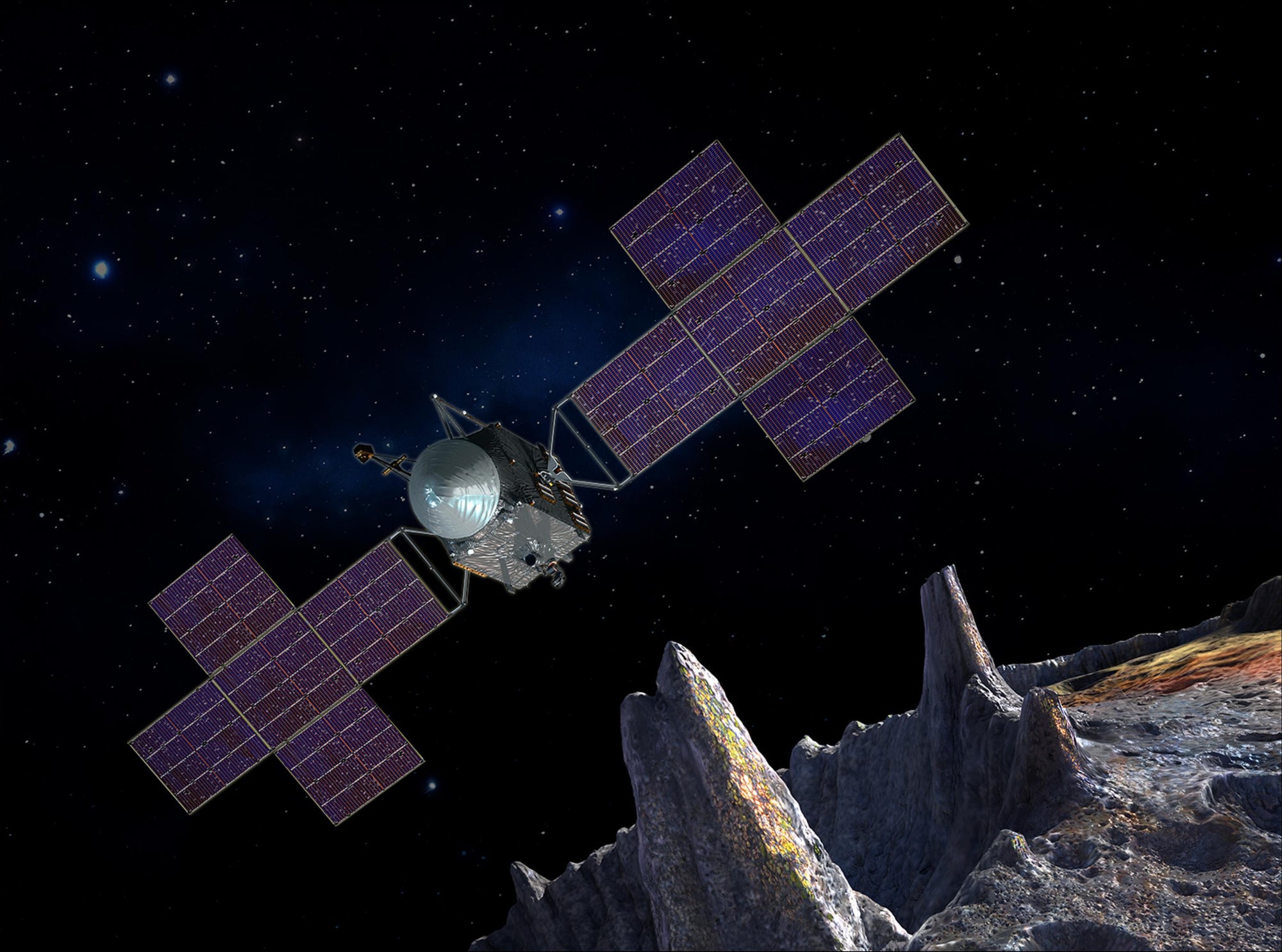
A rendering of the Psyche spacecraft at its destination, the metal-rich asteroid of the same name.
NASA/JPL-Caltech/Arizona State Univ./Space Systems Loral/Peter Rubin
But the flyby is certain to supply stunning new pictures of Mars itself. “We will get better images of the surface of Mars than Artemis II got at the moon,” Williams says. The spacecraft will soar over craters and plains and may be able to spot dust features and lava flows. As it parts ways from the planet, it will have a clear view of an ice cap as well. “It’s the full gamut of Mars geology,” he says. The images won’t be available live due to data constraints, but the mission team hopes to share flyby views beginning next week.
The Psyche team is also coordinating its observations during the flyby with those of the Mars orbiters that are accustomed to studying the Red Planet all the time. Comparing data with these missions will allow the mission scientists to hone their calibration of the imaging instruments, sharpening the interpretation of their data once the mission arrives at the asteroid Psyche. But it may also help scientists discover something new on Mars itself.
“I think it’s lovely to realize that, even with a flyby just for the gravity assist, we can learn things about Mars that we didn’t know,” Elkins-Tanton says, “even though we think of Mars as so familiar.”