Nations Get Busy Inside the Arctic Circle  

As ice retreats, countries are expanding military seaports, exploiting shipping lanes and exploring for oil and gas

Katie Peek

Join Our Community of Science Lovers!


On supporting science journalism

If you're enjoying this article, consider supporting our award-winning journalism by subscribing. By purchasing a subscription you are helping to ensure the future of impactful stories about the discoveries and ideas shaping our world today.


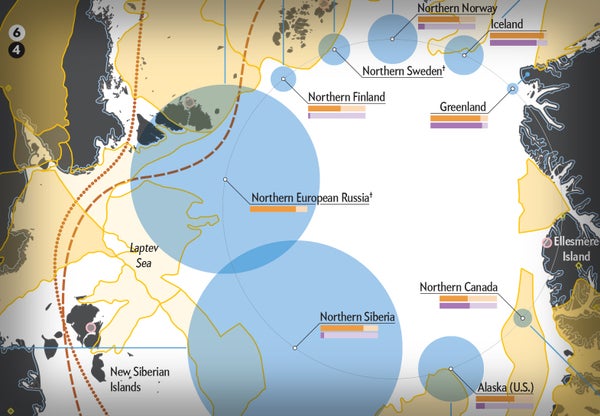
As the Arctic thaws, it becomes much more accessible—and desirable. An exhaustive 2008 U.S. Geological Survey study determined that 13 percent (90 billion barrels) of the world's undiscovered oil and 30 percent (1,670 trillion cubic feet, or 47 trillion cubic meters) of its undiscovered natural gas lie waiting (map). About half the Arctic Ocean is less than 500 meters deep, readily reachable by drilling rigs where sea ice has retreated. Countries, notably Russia, are building numerous airports, seaports and other infrastructure. And they are expanding military installations to protect assets and sustain increasingly busy shipping lanes.

Credit: Katie Peek (graphics); Mark Fischetti (text); Sources: U.S. Geological Survey (oil and gas data); Greg Fiske, Woods Hole Research Center, with data from spacequest.com (shipping data); The Indigenous World 2019, edited by David N. Berger et al. International Work Group For Indigenous Affairs, 2019 (Sami and Inuit populations); Statistics Finland; Statistics Sweden; Statistics Norway; Statistics Iceland; Statistics Greenland; Statistics Canada; U.S. Census Bureau; Russian Federal State Statistics Service; Arctic Portal (Northwest and Northeast Passages); International Institute for Strategic Studies (military installations); Heritage Foundation (military installations); GeoNames Gazetteer (populated places, airports); World Port Index (ports

Katie Peek is a science journalist and data-visualization designer with degrees in astrophysics and journalism. She is a contributing artist for Scientific American.

More by Katie Peek

Mark Fischetti was a senior editor at Scientific American for nearly 20 years and covered sustainability issues, including climate, environment, energy, and more. He assigned and edited feature articles and news by journalists and scientists and also wrote in those formats. He was founding managing editor of two spin-off magazines: Scientific American Mind and Scientific American Earth 3.0. His 2001 article “Drowning New Orleans” predicted the widespread disaster that a storm like Hurricane Katrina would impose on the city. Fischetti has written as a freelancer for the New York Times, Sports Illustrated, Smithsonian and many other outlets. He co-authored the book Weaving the Web with Tim Berners-Lee, inventor of the World Wide Web, which tells the real story of how the Web was created. He also co-authored The New Killer Diseases with microbiologist Elinor Levy. Fischetti has a physics degree and has twice served as Attaway Fellow in Civic Culture at Centenary College of Louisiana, which awarded him an honorary doctorate. In 2021 he received the American Geophysical Union’s Robert C. Cowen Award for Sustained Achievement in Science Journalism. He has appeared on NBC’s Meet the Press, CNN, the History Channel, NPR News and many radio stations.

More by Mark Fischetti
Scientific American Magazine Vol 321 Issue 2This article was published with the title “The Busy North” in Scientific American Magazine Vol. 321 No. 2 (), p. 44
doi:10.1038/scientificamerican0819-44

It’s Time to Stand Up for Science

If you enjoyed this article, I’d like to ask for your support. Scientific American has served as an advocate for science and industry for 180 years, and right now may be the most critical moment in that two-century history.

I’ve been a Scientific American subscriber since I was 12 years old, and it helped shape the way I look at the world. SciAm always educates and delights me, and inspires a sense of awe for our vast, beautiful universe. I hope it does that for you, too.

If you subscribe to Scientific American, you help ensure that our coverage is centered on meaningful research and discovery; that we have the resources to report on the decisions that threaten labs across the U.S.; and that we support both budding and working scientists at a time when the value of science itself too often goes unrecognized.

In return, you get essential news, captivating podcasts, brilliant infographics, can't-miss newsletters, must-watch videos, challenging games, and the science world's best writing and reporting. You can even gift someone a subscription.

There has never been a more important time for us to stand up and show why science matters. I hope you’ll support us in that mission.

Thank you,

David M. Ewalt, Editor in Chief, Scientific American

Subscribe