
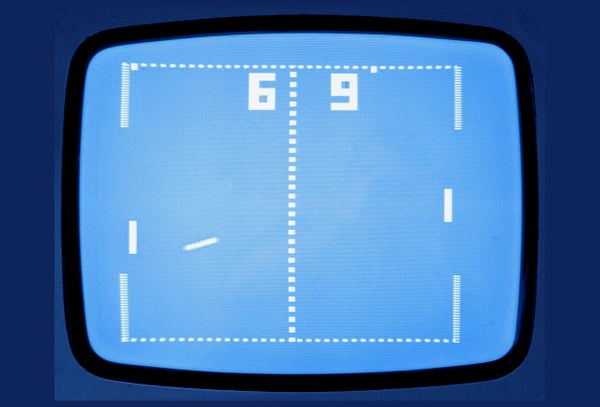
Hundreds of thousands of human neurons growing in a dish coated with electrodes have been taught to play a version of the classic computer game Pong.
In doing so, the cells join a growing pantheon of Pong players, including pigs taught to manipulate joysticks with their snouts and monkeys wired to control the game with their minds. (Google’s DeepMind artificial-intelligence (AI) algorithms mastered Pong many years ago and have moved on to more-sophisticated computer games such as StarCraft II.)
The gamer cells respond not to visual cues on a screen but to electrical signals from the electrodes in the dish. These electrodes both stimulate the cells and record changes in neuronal activity. Researchers then converted the stimulation signals and the cellular responses into a visual depiction of the game. The results are reported today in Neuron.
On supporting science journalism
If you're enjoying this article, consider supporting our award-winning journalism by subscribing. By purchasing a subscription you are helping to ensure the future of impactful stories about the discoveries and ideas shaping our world today.
Intelligence in a dish
The work is a proof of principle that neurons in a dish can learn and exhibit basic signs of intelligence, says lead author Brett Kagan, chief scientific officer at Cortical Labs in Melbourne, Australia. “In current textbooks, neurons are thought of predominantly in terms of their implications for human or animal biology,” he says. “They’re not thought about as an information processor, but a neuron is this amazing system that can process information in real time with very low power consumption.”
Although the company calls its system DishBrain, the neurons are a far cry from an actual brain, Kagan says, and show no signs of consciousness. The definition of intelligence is also hotly debated; Kagan defines it as the ability to collate information and apply it in an adaptive behaviour in a given environment.
Cortical Labs’ work follows on work by neuroengineer Steve Potter, now at the Georgia Institute of Technology in Atlanta, and his colleagues. In 2008, the team reported that neurons cultured from rats can exhibit learning and goal-directed behaviour.
The work from Cortical Labs brings more-sophisticated technology and analytical tools to bear, says Potter. His original dishes had dozens of electrodes; each DishBrain has thousands. Potter’s group studied only rodent cells, but the DishBrain team also tested neurons derived from human cells.
The researchers used their system to teach the neurons to respond to an electrical signal that is a substitute for the ball in Pong. In the game, a player slides a vertical paddle up and down the screen to intercept a bouncing ball. In the experiment, the neurons controlled the paddle.
The authors represented the route of the ball by stimulating neurons along the ball’s path relative to the paddle. Responses from neurons in another region of the network were used to move the paddle up or down.
To teach the neurons to hit the ball, Kagan says, he and his team harnessed the theory that neurons tend to repeat activity that yields a predictable environment. When the neurons responded in a way that corresponded with hitting the ball, they were stimulated in a location and at a frequency that was the same each time. If they missed the ball, the network was stimulated by the electrodes in random locations and at different frequencies. Over time, the neurons learnt to hit the ball to receive the patterned response rather than the random one.
Not just a game
The work is an important step towards developing assays that could be used, for example, to test the potential effect of a new drug on neuronal function, says neuroscientist Takuya Isomura at the RIKEN Center for Brain Science in Saitama, Japan. But, he adds, it is not yet clear whether the neurons were behaving as they did to create a predictable environment, or in response to some other aspect of the signals they received. “I think the important next step is a detailed explanation of what kind of stimuli can actually make that difference,” he says.
Cortical Labs also aims to eventually use neurons to develop “biological processing units” for use in computing. And the techniques developed for DishBrain are quantitative enough that they could be used to compare variations in learning between different animals, or between cells from multiple regions of the brain, says Potter.
In the meantime, he says, the decision to embody DishBrain activity as the game Pong was a masterstroke. “People interested in AI are very keen on anything that can play Pong,” Potter says. “That was a brilliant decision.”
This article is reproduced with permission and was first published on October 12 2022.